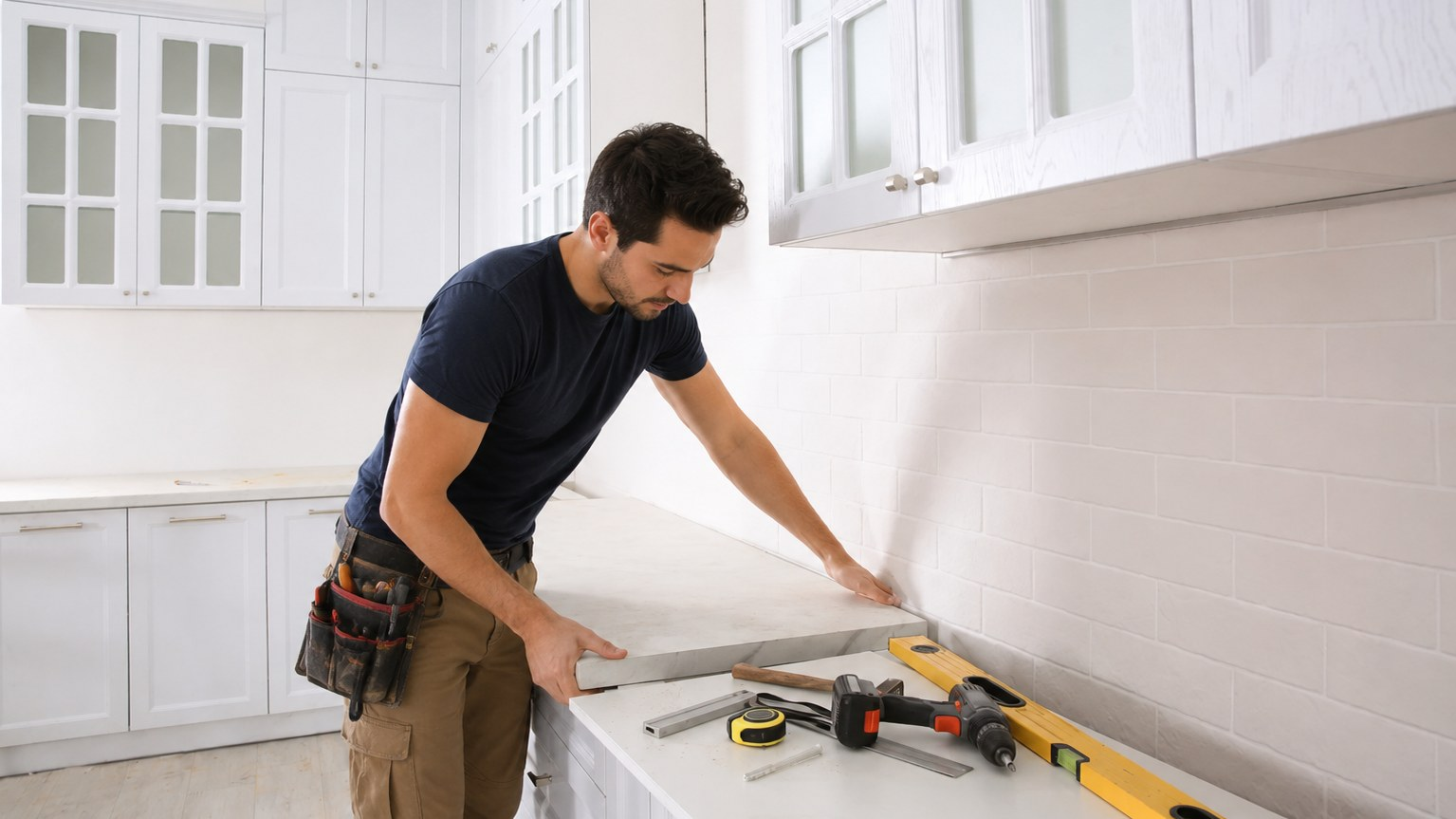
Natural Stone: Igneous, Metamorphic and Sedimentary
Natural stone splits three ways by how the rock formed, and that origin predicts almost everything the finished top does.
Igneous
{{LINK:material:granite}} is the only igneous surface in common countertop use. Coarse grained, 20 to 60 percent quartz by volume, compressive strength usually above 200 MPa, about 29,000 psi. Primary permeability is poor, but secondary permeability runs through cracks and fissures, which is what an impregnating sealer closes off.
Metamorphic
{{LINK:material:quartzite}} is metamorphosed quartz sandstone, at least 80 percent quartz by volume to earn the name. Its crystals interlock so completely that it fractures through the grains. Much of the slab sold as quartzite is actually dolomite, so we verify before we quote.
{{LINK:material:marble}} is calcareous and acid reactive, near 3 on the Mohs scale. {{LINK:material:dolomite}} sits between marble and quartzite in hardness and is often mislabeled in the yard. {{LINK:material:soapstone}} is talc rich and unbothered by heat. {{LINK:material:slate}} is fine grained and quietly durable.
Sedimentary and the softer stones
{{LINK:material:limestone}} and {{LINK:material:travertine}} are calcareous and soft, beautiful on a vanity and demanding in a kitchen. {{LINK:material:onyx}} is the showpiece, often backlit, a display surface not a prep surface.
Engineered Surfaces: Resin-Bound and Sintered
{{LINK:material:quartz}} leads the category at 90 to 93 percent silica by weight, bound in 7 to 10 percent unsaturated polyester resin. The Bretonstone vibrocompression vacuum process leaves it non porous, so it never needs a sealer. Slabs arrive in 12mm, 20mm and 30mm and cure 24 to 48 hours before polishing.
{{LINK:material:porcelain}} and {{LINK:material:sintered-stone}} are fired rather than resin bound, which is why they hold color under sun that would wreck a quartz slab. {{LINK:material:solid-surface}} is an acrylic composite whose glued joints sand flat, so seams disappear and an integrated sink sands flush.
{{LINK:material:terrazzo}} and {{LINK:material:recycled-glass}} round out the category. Recycled glass sits in a concrete or polyester binder, and the binder, not the glass, decides the maintenance story.
Porosity, Sealing and Real Maintenance Load
Sealing is the most oversold service in this trade. Unsealed natural stone can harbor bacteria and stain, a genuine reason to seal it. But modern oleophobic impregnators have pushed sealing out to once every five to ten years, not annually. Engineered quartz never needs it.
The stones that genuinely demand attention are the calcareous ones. Marble, limestone and travertine react to acid, so a lemon slice leaves an etch no sealer prevents, because etching is a reaction with the stone rather than a stain on top.
Heat, Scratch and Impact Behavior Compared
| Material | Porosity | Sealing need | Heat behavior | Scratch resistance | Outdoor suitability |
|---|---|---|---|---|---|
| Granite | Low primary, secondary through cracks | Impregnator every five to ten years | Melts at 1,215 to 1,260 C | High, 20 to 60 percent quartz | Excellent, color stable in sun |
| Engineered quartz | Non porous by manufacture | Never | Stable below 150 C (300 F), harmed by thermal shock | Very high, Mohs about 7 | Unsuitable, UV degrades the binder |
| Marble | Porous, calcareous | Regular impregnator, still etches | Better than resin bound surfaces | Low, Mohs about 3 | Limited, polish dulls outdoors |
| Quartzite | Dense interlocking quartz mosaic | Light, mainly paler slabs | Very high, no binder | Very high, fractures through grains | Excellent, resists weathering |
| Soapstone | Non porous, talc rich | None, oil is cosmetic | Takes direct heat | Soft, marks burnish in | Good, weathers to a patina |
| Solid surface | Non porous acrylic composite | Never | Poor, keep hot cookware off | Scratches, sands out flush | Poor, expands unevenly |
| Porcelain and sintered stone | Non porous fired body | Never | Very high | Very high | Excellent, colorfast under UV |
| Recycled glass | Glass non porous, binder varies | Concrete binders take a sealer | Glass resists about 700 F | Good, edges chip | Depends on binder |
{{LEAD_FORM:mid}}
Indoor Versus Outdoor Suitability in Central Texas Sun
Austin gets about 2,650 hours of sunshine a year and July and August highs above 95 degrees. That decides any surface going on a patio.
Continuous ultraviolet exposure discolors engineered quartz and breaks down the resin holding it together, which puts it firmly indoors. Solid surface has the same problem. What goes outside is granite, quartzite, soapstone, porcelain and sintered stone. Our {{LINK:service:outdoor-kitchen-countertops}} work uses those only.
Matching a Material to How You Actually Cook
You cook hot and often
Granite, quartzite or soapstone. All three take heat without a trivet between you and a repair.
You want to think about it never again
Engineered quartz. Non porous, no sealer, most resistant to discoloration. Keep hot pans on a trivet.
You bake, and looks matter most
Marble. It stays cool under dough, it is beautiful, and it will etch. Accept that trade or choose honed quartzite.
You are outfitting a rental or a busy household
Quartz indoors, granite or porcelain outdoors. Both survive tenants and teenagers. Once the material is settled, {{LINK:service:countertop-templating-and-measurement}} captures the room, {{LINK:service:custom-countertop-fabrication}} builds the pieces, and {{LINK:service:countertop-sealing-and-polishing}} handles upkeep. See the {{LINK:archive:service}} page.
Material Selection Across Our Service Area
Slab preference tracks geography. Hill Country properties in {{LINK:location:dripping-springs}} and {{LINK:location:bee-cave}} lean outdoor rated. Newer builds in {{LINK:location:cedar-park}} and {{LINK:location:pflugerville}} lean quartz. Lakefront remodels in {{LINK:location:lakeway}} split. See the {{LINK:archive:location}} page, or {{LINK:home}} for how a project runs.
Common Questions About Countertop Materials
Which material needs the least upkeep?
Engineered quartz, comfortably. It is non porous out of the press, so it never needs sealing, and it resists discoloration better than anything else in common use. Porcelain and sintered stone are close behind and add outdoor tolerance. Keep hot cookware off quartz and you are done.
What is the most durable countertop?
Depends which failure you care about. For scratch and heat together, quartzite is hard to beat, at least 80 percent interlocking quartz with no binder to soften. Granite wins on compressive strength. Engineered quartz wins on stain resistance. Marble wins none of these, and people buy it anyway.
Which materials can go outside?
Granite, quartzite, soapstone, porcelain and sintered stone. Engineered quartz and solid surface should not, because ultraviolet exposure discolors quartz and breaks down its resin binder. With 2,650 annual sunshine hours, that is not theoretical.
How do I compare two materials I like?
Bring both names to the estimate. We will put your actual habits against the porosity, sealing load, heat behavior and outdoor suitability above, and tell you which fits your room. Call {{PHONE}} to schedule the free in home visit.