
Granite: yes
UV stable, heat resistant, handles a grill surround. Wants sealing more often outdoors than in, because it is exposed to far more.
Austin · West Lake Hills · Rollingwood · Barton Creek · Lakeway
Austin Custom Countertops fabricates and installs outdoor kitchen countertops in Austin, TX, and is Travis County's trusted specialist in stone that lives outdoors, specializing in granite countertop fabrication for grill surrounds, large format porcelain mitred to a heavy apron, and drainage detail on bar tops left open to the weather. We offer serving counters cut around an existing grill insert and frost resistant surfaces for covered patio kitchens.
Request a FREE Quote!
Our team provides a straight answer on material before anything is cut, because the polyester resin in engineered quartz is not UV stable under about 2,650 hours of Austin sunshine a year, delivering granite that keeps its color for homes and porcelain countertops that come through a freeze and thaw cycle intact for both residential and commercial projects. We cut porcelain on our own CNC in our Austin shop, where the tooling and the handling stay with our crew instead of going out to a subcontractor, from one grill surround to a full outdoor countertop package templated alongside the indoor run.
From the fall on a bar top that sheds rain off the front instead of into a joint to a complete patio kitchen set in a single morning, our team handles every detail. Serving Austin, Lakeway and Steiner Ranch to the west, we build for the weather the stone will actually sit in.
This is the most useful thing on this page, so it goes first. Engineered quartz is not a slab of quartz. It is roughly 90 to 93 percent crushed quartz aggregate by weight, held together by 7 to 10 percent polyester resin. By volume that resin is closer to a third of the material. Everything you like about a quartz countertop indoors, the nonporous surface, the consistent color, the lack of sealing, comes from that resin.
Polyester resin is not UV stable. Under continuous ultraviolet exposure it discolors and the binder itself breaks down. That is not a maintenance issue and there is no sealer that stops it. The surface yellows or fades, and it fades unevenly, because the part of the counter under the grill hood and the part sitting in full afternoon sun are getting completely different doses. Once the binder starts to go, the aggregate at the surface is no longer being held the way it was designed to be held.
Central Texas gives that process everything it needs. The counter is also being cycled through big daily temperature swings, and engineered quartz is already the material that dislikes sudden temperature change most.
Most quartz manufacturers exclude outdoor and direct sun installation from their warranty coverage for exactly this reason. So a homeowner who buys an outdoor quartz counter is buying a material that is known to degrade in the application, with no coverage when it does. We would rather lose the sale on the phone than do that. If you want the look of a light, uniform quartz outdoors, ask us about porcelain instead.
Granite is the traditional answer and it is still a good one. It is a dense igneous rock of quartz, feldspar, mica and plagioclase, running about 2.65 to 2.75 grams per cubic centimeter, with compressive strength usually above 200 megapascals and poor primary permeability. Nothing in it is holding it together except itself, so there is no binder to break down in the sun. Granite has been used as exterior dimension stone on buildings for centuries, which is a longer field test than any countertop material can claim.
Porcelain is the newer answer and it is excellent for this. A porcelain slab is clay, feldspar and quartz fired at peak temperatures around 1,200 degrees Celsius, which vitrifies the body and seals the internal pores. By definition it absorbs less than 0.5 percent water, and the result is a monolithic, chemically inert, frost resistant slab. Color is fired in rather than resin bound, so sun does not touch it. Slabs come as large as roughly 1,600 by 3,200 millimeters, which covers most outdoor runs with no seam at all.
The practical difference is thickness. Porcelain outdoor slabs are usually thin, so a substantial looking edge is built by mitering the slab and returning an apron, which is shop work. Granite comes as a three centimeter slab and looks heavy without help. Both need a crew who has cut them before. Porcelain is unforgiving of bad tooling and bad handling, and we cut ours on our own CNC here in Austin rather than sending it out.
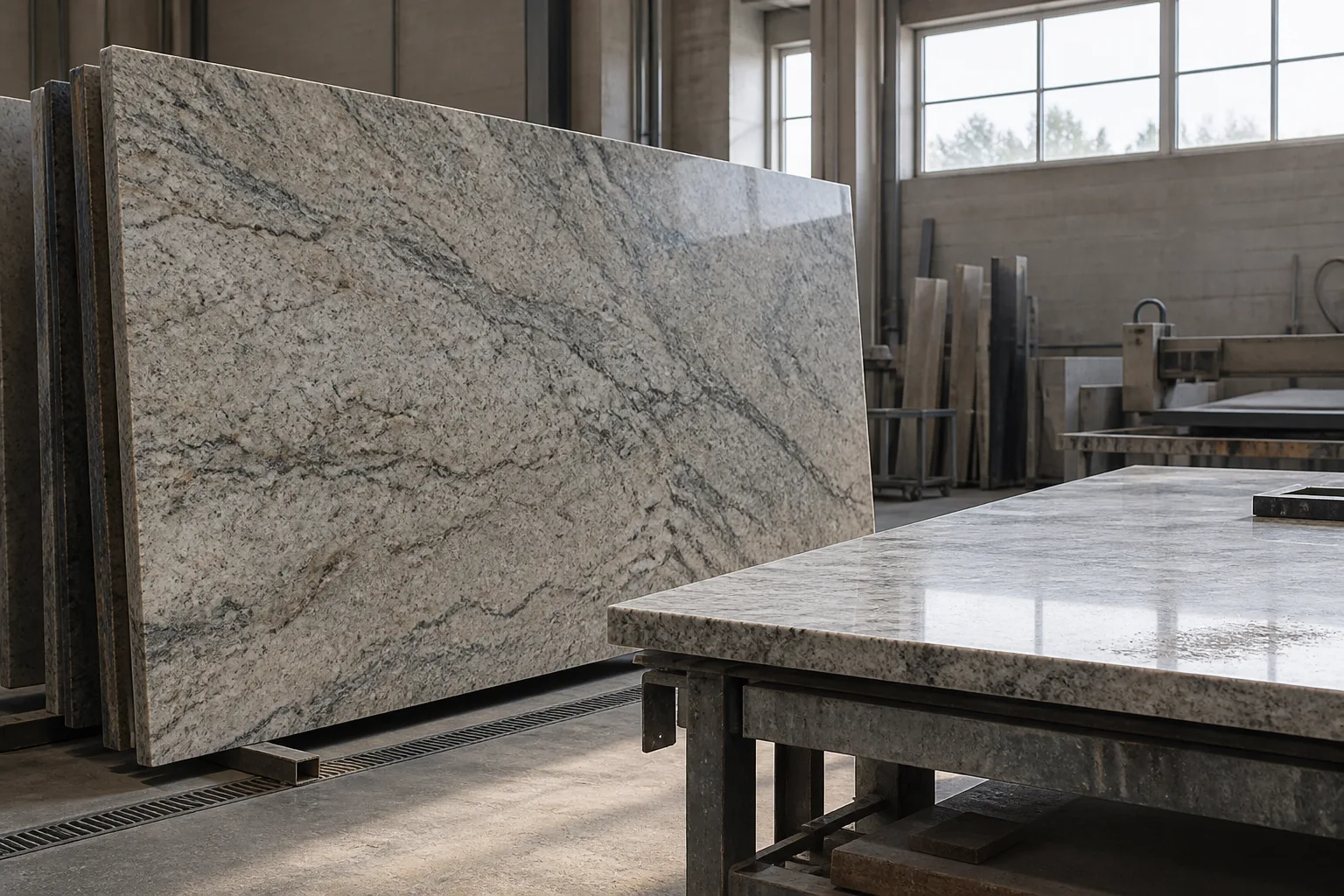
Austin reaches 90 degrees on about 123 days a year and 100 degrees on roughly 29 of them in an average year. The all time record high is 112.
A dark polished granite sitting in that sun gets far hotter than the air temperature, and it holds the heat into the evening, which is when people actually use an outdoor kitchen. It also glares. Honed and leathered finishes look better outdoors for both reasons, and they hide water spotting from the hose better than a polish does.
Thermal movement is the other half of it. Stone expands and contracts with the daily swing, and in a rock made of different minerals that expansion is not uniform grain to grain. So the countertop must be allowed to move. We bed outdoor slabs on silicone rather than locking them into rigid mortar, leave the perimeter free rather than trapping the stone against stucco or a wall return, and keep cutouts away from the points where the counter is most restrained. A granite top also wants sealing on a real schedule outdoors, because its secondary permeability runs through fractures and fissures, and the west facing end of the counter will need it sooner than the shaded end.
People building in Austin underestimate this, and February 2021 is the reason to take it seriously. Camp Mabry stayed at or below freezing for 144 consecutive hours that month.
Water expands about 9 percent when it freezes, and in porous material the more damaging mechanism is ice segregation, where liquid water migrates through the pores to feed growing ice lenses. Both need one condition: material that is close to saturated. A dense, well sealed granite or a porcelain slab under 0.5 percent absorption does not get there. A porous unsealed stone, an open seam holding water, or an untreated substrate under the slab absolutely does.
So outdoor detailing is mostly about not letting water sit or soak. We slope the top slightly away from the house so rain runs off instead of pooling against the back edge. Seams get a proper exterior rated joint, not an interior filler. Sink and grill cutouts are sealed on the cut edge, since that raw edge is the most absorbent part of any countertop. Drain the sink and the lines before a hard freeze, and cover the grill cutout so the opening in your counter is not a bucket.
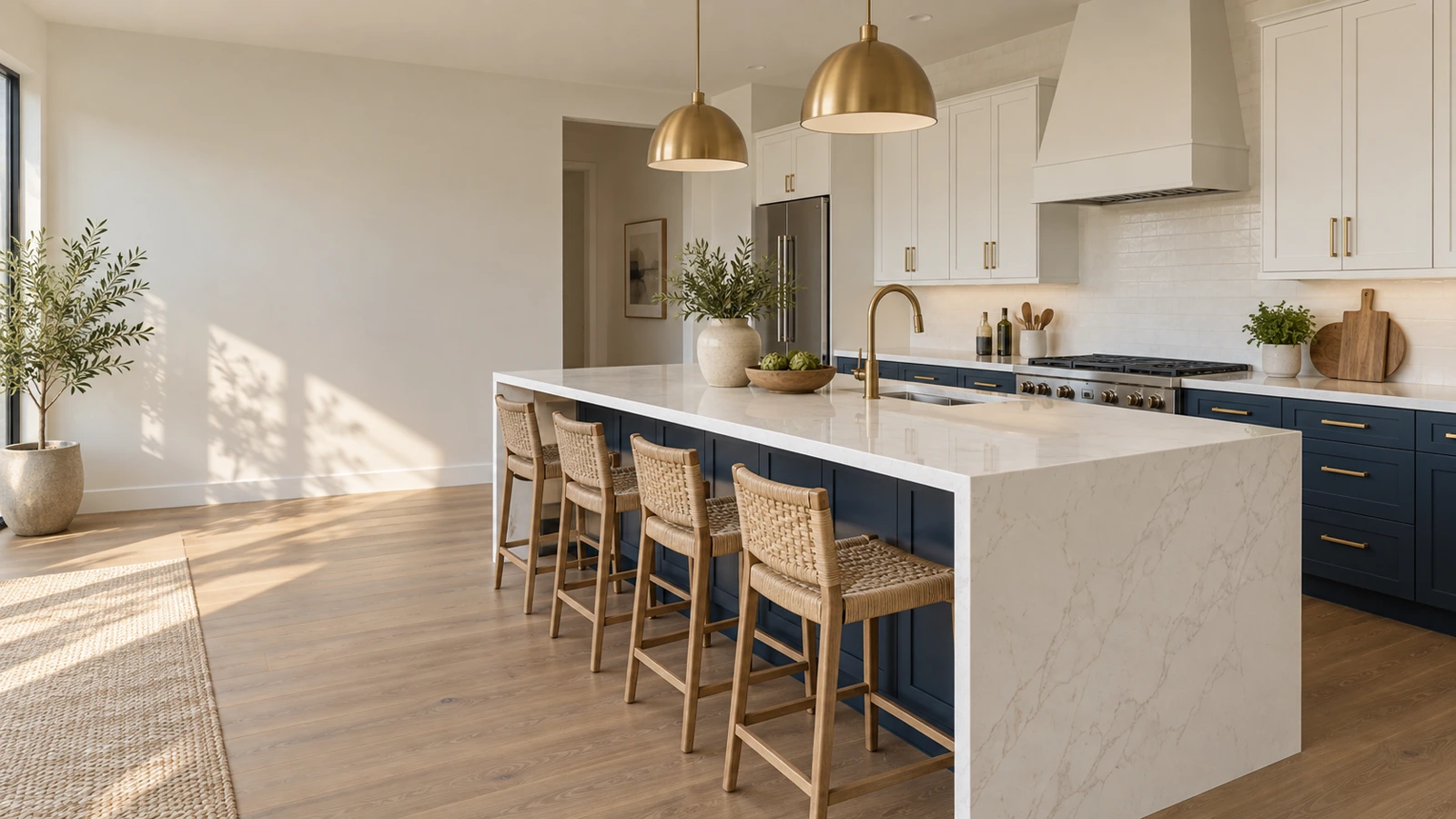
An outdoor kitchen is not cabinetry. The counter usually lands on a block structure or on a galvanized steel stud frame skinned with cement board and finished in stucco, stone veneer or brick. That changes two things about our work.
First, the base is never as square or as flat as a set of cabinets. Masonry is built to a line, not to a millimeter, and a stone slab will not flex to follow it. So we laser template off the finished base after it is built and skinned, not off a plan, and we template at the stage where the finish thickness is known. That single step is what keeps a three centimeter granite from rocking on a high spot or showing a shadow gap along a stucco wall.
Second, every appliance cutout removes support. A built in grill, a side burner, an under counter refrigerator and access doors all open up the very spans the slab was going to bear on. Those openings need steel or masonry support across them, sized and placed before the slab arrives. Bar overhangs follow the same limits as any stone countertop: roughly eight to ten inches unsupported on three centimeter granite, no more than about a third of the depth, and hidden brackets at eighteen to twenty four inches on center beyond that.
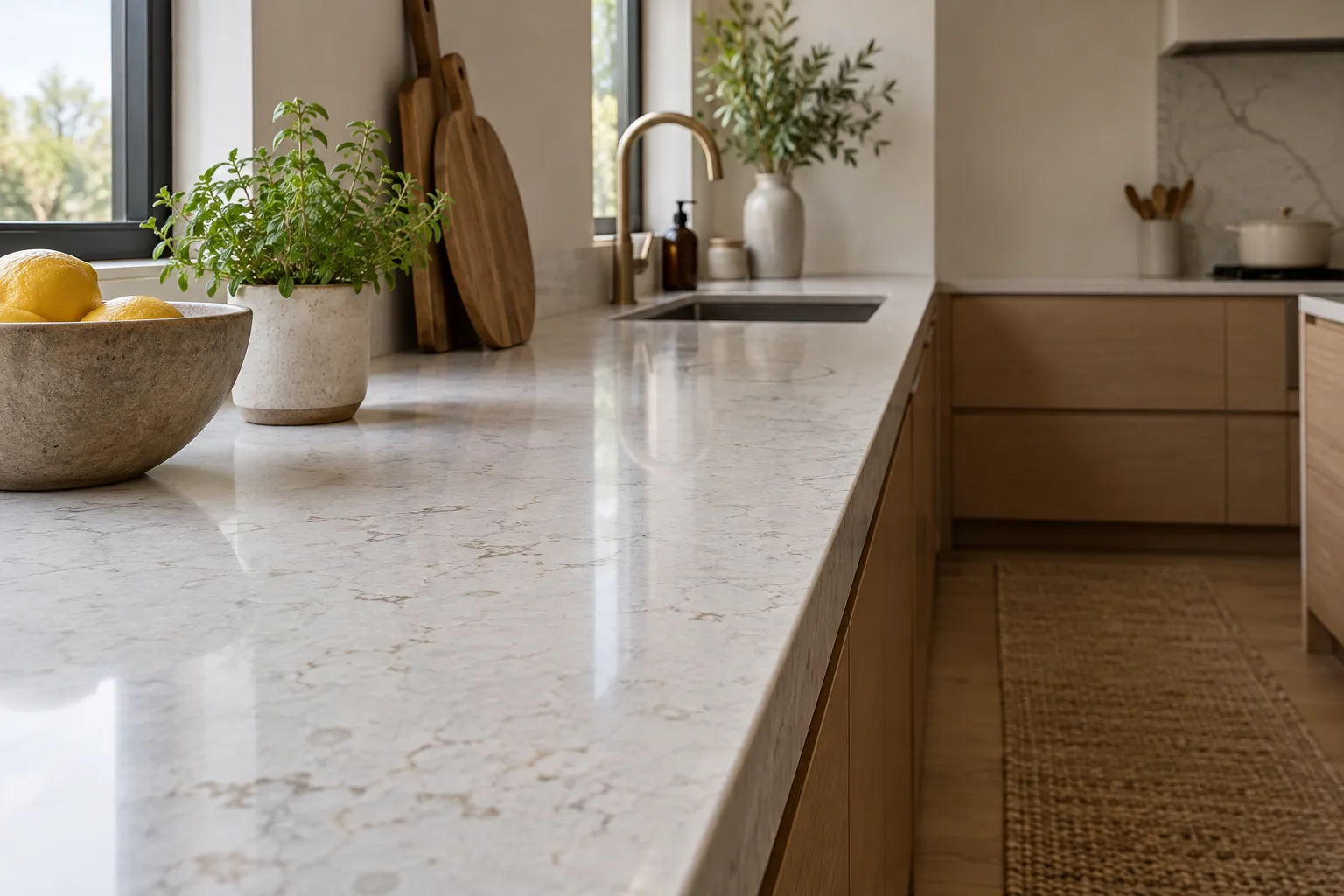
We quote one firm price for the finished countertops, and it is set at the template, not guessed from a photograph. We do not publish a square foot figure because the same square footage can be two very different jobs outdoors.
Material is the first driver. Granite and porcelain are not priced alike, and within each there is a wide range depending on the block, the color and the availability of the slab. Porcelain needs mitered aprons to look thick, which is real shop time on every visible edge, so a thin porcelain slab with four returned edges is not automatically cheaper than a three centimeter granite with a simple eased edge.
Cutouts are the second driver, and outdoor kitchens have more of them than indoor ones. A grill, a side burner, a sink, a beverage center and two access doors mean several openings, each one cut, finished on the raw edge, and each one needing its own support detail across the span it interrupts. Layout complexity matters here too. An L shaped or U shaped counter around a corner has more pieces, more seams and more edge work than one straight run.
After that: the length of the runs and whether they exceed slab size, the number of slabs the layout consumes, the finish you choose, how far the counter overhangs for seating and what it takes to carry that, and access to the site. Getting slabs to a terraced backyard build is a different job from a flat side gate, and we would rather tell you that at the template than on install day.
UV stable, heat resistant, handles a grill surround. Wants sealing more often outdoors than in, because it is exposed to far more.
Completely UV stable, non-porous, very thin and light. Best for a fully exposed run. More brittle to fabricate, so edges and cutouts need care.
The resin binder is not UV stable. It yellows and can warp in direct sun, and most manufacturers void the warranty outdoors. We will not install it outside.
A built-in grill needs the manufacturer's clearance around the opening. We cut to the appliance spec sheet, not to a generic size.
Granite and porcelain are the two that last. Granite handles heat and sun and wants sealing. Porcelain is completely UV stable and non-porous, comes in large-format slabs, and is the better choice for a fully exposed run.
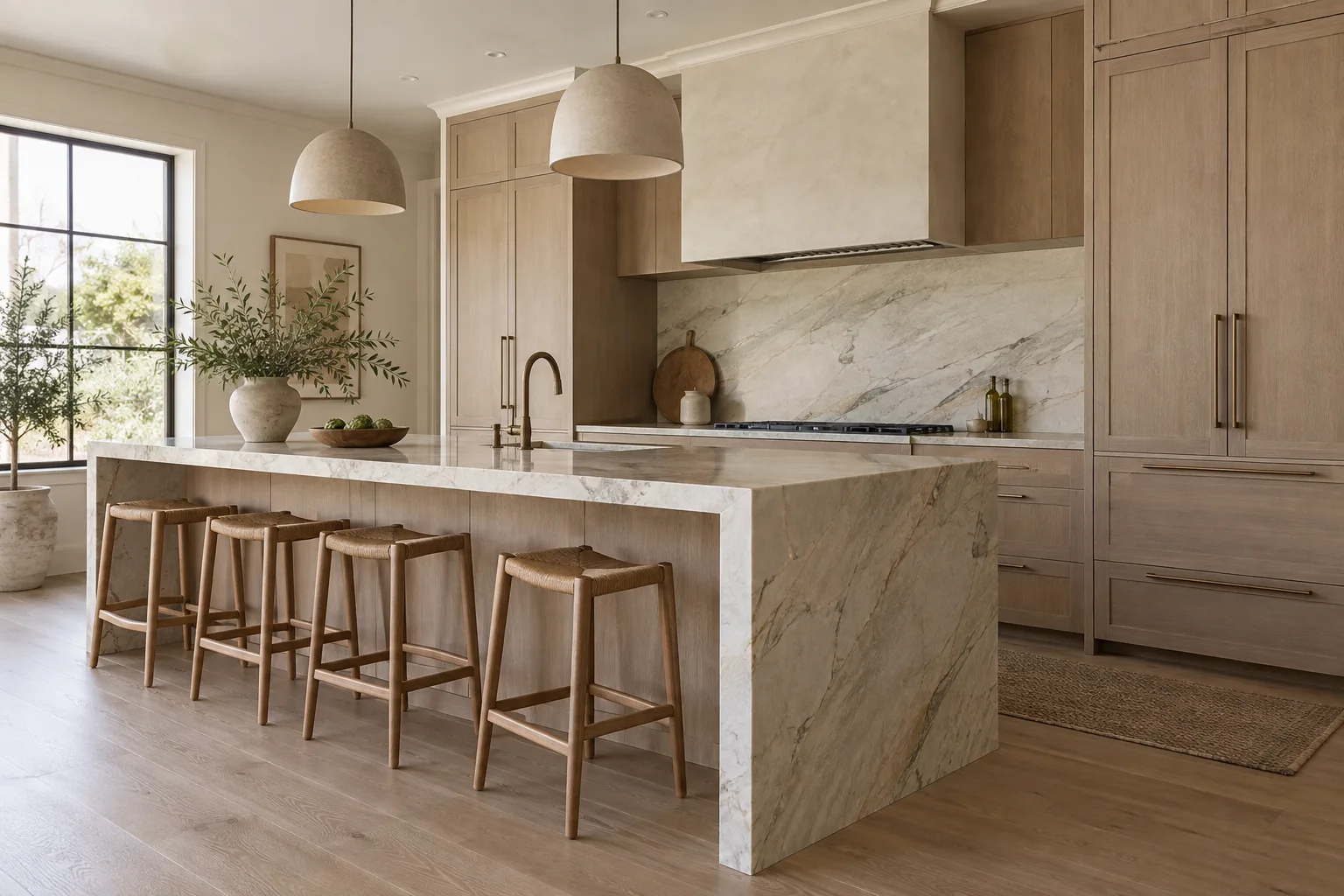
We laser template off your cabinets and confirm sink, cooktop and overhang details in about an hour.
You choose your actual slab rather than a sample chip, so the movement and veining you approve is the one that gets installed.
Cut, edged and polished in our Austin shop, typically five to ten working days from template.
Old tops out, new tops set and seamed, sink and cooktop refitted. Most kitchens finish in a day.
We still say no, and we will say no on the phone before you spend anything. Covered is not sealed. The counter still gets reflected and low angle ultraviolet light, and it still takes the full daily temperature swing. Since the resin binder degrades under sustained exposure and most manufacturers exclude outdoor installation from warranty either way, you would be carrying the entire risk yourself.
Both are correct answers outdoors. Choose granite if you want depth and movement in a natural stone and a heavy looking three centimeter edge with no extra fabrication. Choose porcelain if you want a light, uniform, low maintenance surface, a very large piece with no seam, or the visual of a pale quartz without the resin problem.
Granite has no polymer binder to break down, which is the mechanism that fades engineered quartz. What granite does need outdoors is sealing on a schedule, more often on the sun and weather exposed end than on the shaded end.
Porcelain does not. Granite does, and outdoors the interval is shorter than the same stone indoors. We will tell you what your specific slab wants and show you the water test that tells you when it is due, rather than quoting a number that is wrong for half the stones out there.
A dense sealed granite or a porcelain slab handles it, because frost damage needs material close to saturation and neither one gets there. The failures in a freeze are plumbing and standing water. Drain and blow out the sink lines, cover open cutouts so they do not fill, and do not let water sit in an unsealed seam going into a freeze.
Yes, and we need the actual appliance specification sheets before we cut, not the model name. We also need to know what is supporting the base across each opening, since a grill cutout removes the bearing the slab was relying on there.
After the base is built and skinned, and after the finish material thickness is known. We laser template off the finished structure because masonry is never as square as cabinetry, and a slab cut to a drawing will not sit flat on a real block base.
Yes. We template, cut on our own CNC in our Austin shop, and install with our own crew. Nothing is subcontracted, and you get one firm price for the finished countertops.
Free measure across Austin and the surrounding Hill Country. No obligation, and no add-ons at install.
Calls only, we do not receive text messages.