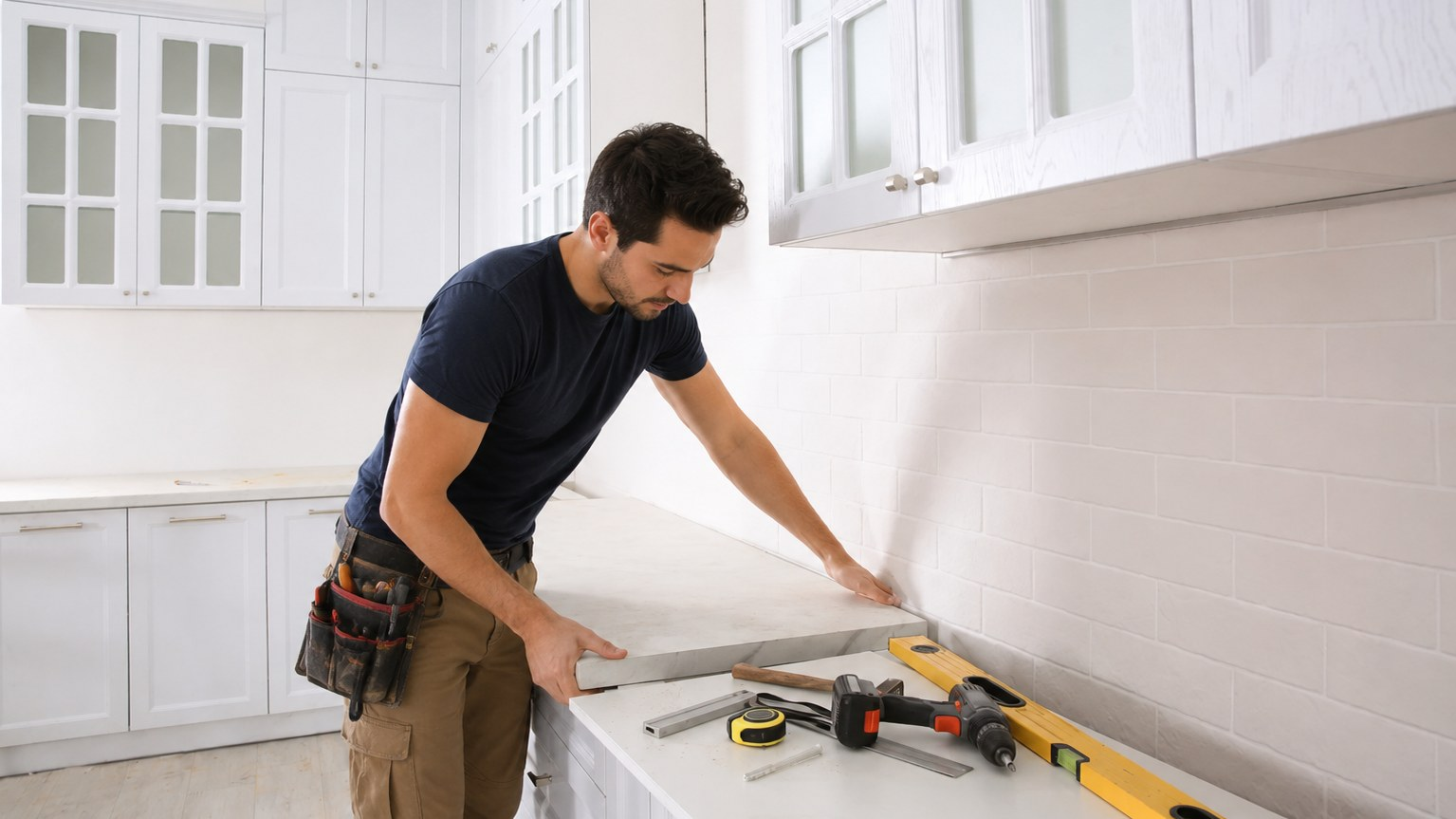
Metamorphosed Limestone: Soft, Calcareous and Reactive by Nature
Marble starts as limestone. Heat and pressure recrystallize the calcium carbonate into an interlocked mosaic of calcite crystals, which gives marble its translucency and that way it seems to hold light just under the surface. The chemistry does not change. Marble is still a carbonate rock, and carbonate reacts with acid.
On the Mohs scale marble sits at about 3. Engineered quartz sits at about 7. A steel knife blade is harder than marble, and so is a ceramic mug bottom. That is not a defect, it is the material, and every honest conversation about marble starts there rather than at the end of the sale.
Etching Is a Chemical Reaction, Staining Is Absorption
Homeowners use these two words interchangeably, and they describe completely different events.
Etching
An etch is a chemical reaction. Acid meets calcite and dissolves a microscopically thin layer of surface, leaving a dull spot where the polish used to be. No sealer stops it, because a sealer fills pores and the acid is attacking the mineral itself.
Staining
A stain is absorption. Oil or pigment migrates into the pore structure and darkens the stone from within. That one a sealer genuinely helps with. So a properly sealed marble counter resists staining and still etches. Anyone who tells you otherwise is selling you something.
The Patina Argument: Living With Marble Rather Than Fighting It
Marble has been used on work surfaces for centuries, and it survived because the culture around it accepted wear. A Parisian pastry counter, a hotel bar top from the 1920s. Neither looks factory new and neither looks bad, because the dulling accumulates into an even soft sheen instead of individual marks.
That is the real decision. If you can look at a ring from a lemon and see history, marble will make you happy for thirty years. If one etch mark will bother you every morning, the right answer is {{LINK:material:quartzite}} for the look with granite manners, or engineered {{LINK:material:quartz}} for a veined white that never changes.
Carrara, Calacatta, Statuario and Danby Compared
These names describe where the stone came from, not how it performs. All four are calcite marbles and all four etch.
Carrara
Quarried in Tuscany, the most common of the group. Soft grey ground with fine, feathery veining that reads as a wash rather than individual lines. The easiest to live with, because subtle veining hides wear better than high contrast does.
Calacatta
Whiter, brighter ground with bolder veining, often with warm gold or taupe in it. Slab yield is lower, so it is rarer than Carrara. It makes seam alignment far more demanding, because a broken vein across a joint is obvious.
Statuario and Danby
Statuario is bright white with strong grey veining, traditionally the sculptor’s marble, and inconsistent block to block, so tagging your actual slabs matters most here. Danby is quarried in Vermont, meaning domestic supply and shorter lead times, reading similar to Carrara with a warmer cast.
{{LEAD_FORM:mid}}
Honed Surfaces Hide Etch Better Than Polished
Polished marble is buffed to a mirror. An etch removes the polish in that spot, so it shows as a dull patch against a reflective field, visible across a room.
Honed marble is finished to a flat matte. An etch still removes material, but there is far less sheen difference between the mark and the stone around it, so it disappears into the surface. That is what we recommend on nearly every marble kitchen counter. The tradeoff is that honed marble is slightly more absorbent, since the pores are not burnished closed, so wiping oil promptly matters more. Leathered is a third option that hides etch and fingerprints well. We keep all three finishes in the same stone so you can compare, and we handle periodic {{LINK:service:countertop-sealing-and-polishing}}.
| Consideration | Polished Marble | Honed Marble | Quartzite | Engineered Quartz |
|---|---|---|---|---|
| Etches from acid | Yes, shows clearly | Yes, far less visible | No if truly quartzite | No |
| Absorbs oil | Lower | Higher, wipe promptly | Low | None |
| Surface hardness | About Mohs 3 | About Mohs 3 | About Mohs 7 | About Mohs 7 |
| Heat tolerance | High | High | High | Low, 300 F resin limit |
| Ages into patina | Yes, unevenly | Yes, evenly | No | No |
| Best room | Baths and bar tops | Kitchen counters | Hard-use kitchens | Any interior room |
Where We Recommend Marble and Where We Talk Clients Out of It
Marble is our first recommendation for a primary bath vanity. The acid load in a bathroom is close to zero and the translucency does something no engineered surface matches, so we do a lot of {{LINK:service:bathroom-vanity-tops}} in Carrara and Danby. It is also excellent for a baking station, because the thermal mass keeps pastry dough cold, and for a fireplace surround.
Where It Is the Wrong Choice
We steer people away from marble on a busy family island where kids do homework and cut fruit, on a wet bar that sees citrus and wine nightly, and on any outdoor kitchen where rain, sun and grill grease land on the same slab. We also say no when a client describes themselves as a perfectionist about surfaces. That is a compatibility test, not a judgment, and it saves everyone a difficult call a year later. In those cases we point to {{LINK:material:dolomite}} as an honest middle, or to quartzite outright.
Related Stones We Fabricate
If marble is the look you want but the maintenance worries you, there are neighbours worth walking in the yard. Softer and warmer, {{LINK:material:limestone}} shares the carbonate chemistry with a chalkier surface. For something theatrical in a powder room, {{LINK:material:onyx}} is in the same family and even more delicate.
Marble Countertop Service Areas
Most of our marble work lands west of Mopac, in the hillside homes where the architecture suits it. We fabricate and install marble in {{LINK:location:west-lake-hills}}, throughout {{LINK:location:lakeway}}, around {{LINK:location:bee-cave}} and out toward {{LINK:location:dripping-springs}}. Our {{LINK:service:marble-countertop-installation}} crews handle the stair carries and tight turns that soft stone makes risky.
Want to see how marble compares against the rest of our board? Start at {{LINK:home}}, then call {{PHONE}} and we will bring finish samples to your kitchen at no charge.
Marble Countertop Questions From Austin Homeowners
Will marble stain in a kitchen?
It can, and sealing substantially reduces the risk. Oil is the real threat, not water. A sealed counter gives you a comfortable window to wipe up olive oil, wine or grease before pigment migrates into the pore structure, and most stains that set will draw out with a poultice. Etching is a separate issue.
What causes etch marks?
Acid reacting with the calcium carbonate in the stone. Lemon, vinegar, wine, tomato sauce, coffee, cola and many bathroom and glass cleaners all do it. The acid dissolves a very thin layer of surface, removing the polish and leaving a dull spot. It is chemistry rather than wear.
Is honed marble better than polished?
For a kitchen counter, yes. Honed marble has no mirror sheen to lose, so an etch blends into the surface instead of standing out against it. The tradeoff is slightly higher absorbency, so prompt wiping matters more. In a bathroom where acid exposure is minimal, polished is a good choice.
Can marble be sealed against etching?
No. An impregnating sealer fills the pore network so liquids cannot soak in, which is why it works against staining. Etching is acid dissolving the calcite crystals at the surface itself, and no penetrating sealer stops that reaction. Topical coatings that claim to carry their own wear problems.
Is marble good for a bathroom vanity?
It is one of the best uses for it. Bathrooms see very little acid, no hot cookware and no knives, so the conditions that trouble marble in a kitchen are absent. Watch acidic toilet and glass cleaners, keep polish remover off the stone, and it looks excellent for decades.
Can marble etching be repaired?
Yes, in most cases. Light etching on a honed surface polishes out with an etch remover and a fine abrasive compound worked by hand. Deeper marks on polished surfaces need professional refinishing of the whole top so the sheen stays uniform. A full hone and reseal often looks like new work.