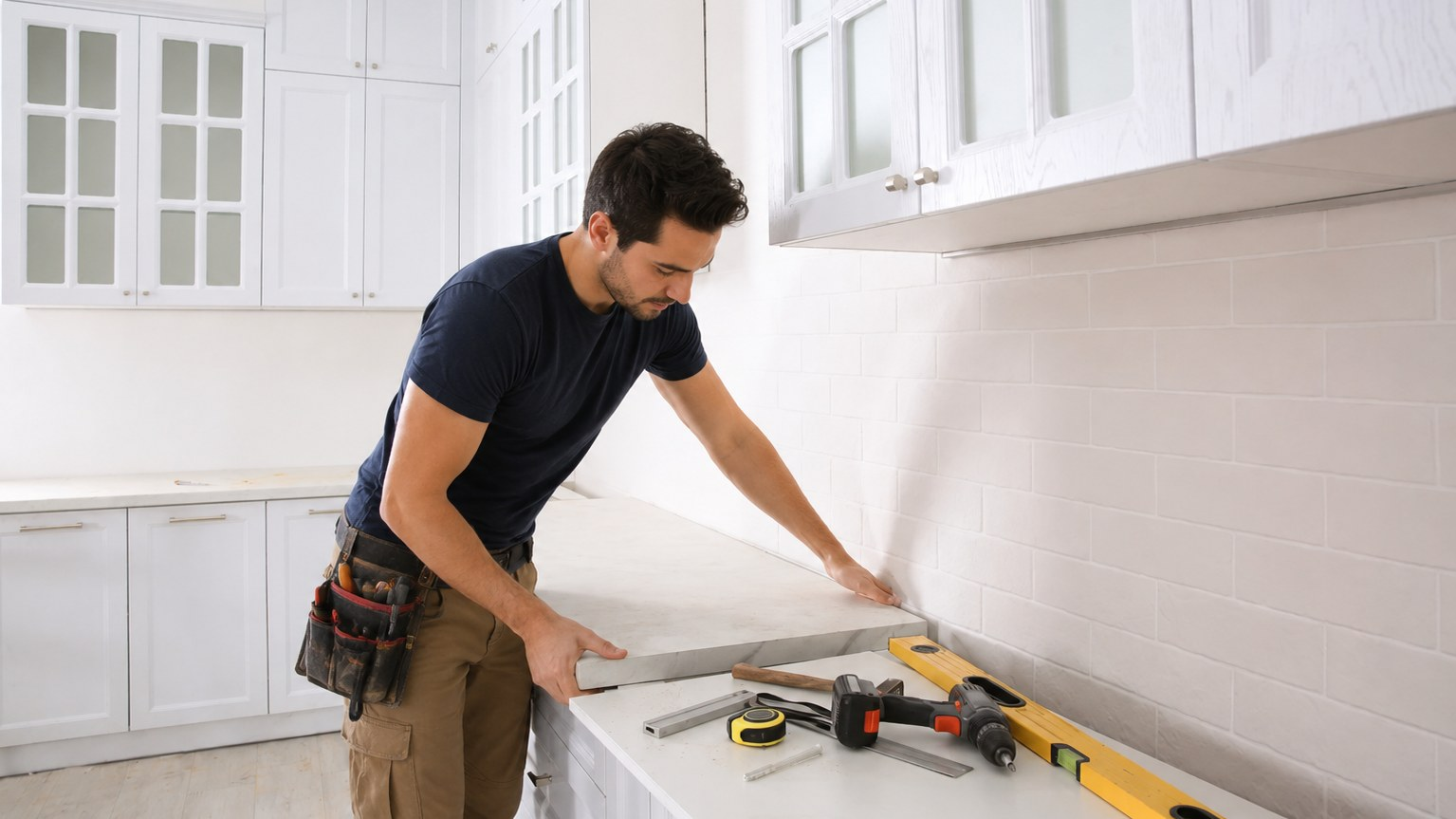
Ultra-Compact Slabs Fired at High Temperature, Typically 6 to 12 Millimeters
Porcelain slab is a ceramic product. Refined clays and mineral powders are pressed and fired in a kiln at very high temperature until the body vitrifies, meaning the particles fuse into a dense, glass-like mass with essentially no open porosity. It arrives as large format slabs, typically 6 to 12 millimeters thick.
Two things follow. The material is non-porous through the body, so it never needs sealing and there is no pore network for stains or bacteria. And it has already survived a kiln, which is why setting a hot pan on it is a non-event, with no polyester resin to soften the way engineered {{LINK:material:quartz}} does at its 300 degree Fahrenheit ceiling. The thinness is the tradeoff: a six millimeter sheet is very strong in compression and very unforgiving in tension.
UV Stable, Which Makes It One of the Few True Outdoor Surfaces
Porcelain is fired ceramic. Ultraviolet light does not degrade it and does not fade the body, because there is no organic binder to attack. Freeze and thaw does not bother a vitrified body either, and rain runs off a non-porous surface without consequence.
In Austin that matters more than almost anywhere. The city runs roughly 2,650 hours of sunshine a year, July and August highs average above 95 degrees Fahrenheit, and 112 has been recorded. A west-facing patio counter takes punishment that would discolor engineered quartz within a few seasons, which is why we will not install quartz on a patio at all. For {{LINK:service:outdoor-kitchen-countertops}}, porcelain and {{LINK:material:sintered-stone}} are our two standing recommendations.
Through-Body Versus Printed Surface Patterns
This is the specification detail that separates a porcelain slab you will be happy with from one you will regret, and most showrooms will not raise it unless you do.
Printed Surface
Most porcelain slabs carry a high-resolution decorated layer applied before the final firing. The imagery reproduces marble veining convincingly. But the pattern lives at the surface. Chip an edge and you expose the body underneath, usually a plain white, grey or tan that does not match the face.
Through-Body
Full-body porcelain carries the color, and in better products some of the veining, through the entire thickness. A chip is far less visible and a mitered edge shows something coherent rather than a stripe of raw body. If you are doing exposed mitered edges or a waterfall, this is what you want. Ask which one you are looking at.
{{LEAD_FORM:mid}}
Mitered Edges Are How You Get Visual Thickness
A twelve millimeter slab set on a cabinet looks like what it is: a thin sheet. Most people want a counter that reads substantial, so the answer is a mitered edge.
The slab face and a matching strip are each cut at forty five degrees, folded together, glued with a color-matched adhesive and dressed so the seam disappears into the corner. The result is a hollow edge presenting whatever thickness you specify. Waterfall island ends use the same technique turned vertical. Done well it is invisible. Done badly it shows as a fine white line down the whole run, which is why miter work is the fairest test of a porcelain fabricator and belongs in {{LINK:service:custom-countertop-fabrication}} rather than on a general remodel crew’s task list.
Cutting and Handling Requires Different Tooling
Porcelain is not cut like stone. Standard segmented granite blades chip the glazed surface and generate heat a thin vitrified sheet does not tolerate. Fabrication uses continuous rim diamond blades, slower feed rates and a saw set up for the material. Interior corners get generous radii and reinforcement, because a square inside corner in a thin brittle sheet is a crack waiting for a reason.
Handling matters as much. A large format slab must be lifted with full-length support, never flexed and never carried on two points. Sink and cooktop openings need reinforcement, and undermount basins need mechanical support rather than adhesive alone. Precise {{LINK:service:appliance-cutouts}} in porcelain is a different job than in granite.
| Property | Porcelain Slab | Sintered Stone | Engineered Quartz | Granite |
|---|---|---|---|---|
| Sealing | Never, vitrified | Never | Never | Every five to ten years |
| UV stability outdoors | Excellent | Excellent | Not suitable | Good |
| Direct heat | Excellent, kiln fired | Excellent | Poor, 300 F resin ceiling | Excellent |
| Typical thickness | 6 to 12mm | Thin to standard | 12, 20 or 30mm | 20 or 30mm |
| Edge vulnerability | Higher, thin and brittle | Higher | Moderate | Low |
| Overlay over existing tops | Yes, common | Yes | Rarely | No |
Porcelain Over an Existing Countertop as an Overlay
Because the slab is thin and light, porcelain can be installed directly over an existing countertop in the right conditions. The old surface stays put as substrate, the new slab bonds over it, and the edges are wrapped. That avoids demolition and turns a multi-day project into a short one. It only works if the existing top is sound, flat and firmly attached. We check that during the measure and tell you honestly whether an overlay or a full {{LINK:service:countertop-replacement}} is the right call.
Where Porcelain Is the Wrong Choice
Porcelain is thin and brittle, so it is more vulnerable at exposed edges and corners than a thick stone slab, and a hard strike from cast iron can chip it. On printed slabs that chip exposes a body color that does not match, and repairs are far harder to hide than on quartz. Seams stay visible, because no color-matched resin trick makes a joint between two ceramic sheets disappear. And a household that wants deep crystalline depth will find porcelain reads flat next to real granite. For seams that genuinely vanish, {{LINK:material:solid-surface}} does something porcelain cannot, and for interior depth without the fabrication complexity, {{LINK:material:terrazzo}} is worth comparing.
Porcelain Countertop Service Areas
Most of our porcelain work is outdoor kitchens and patio bars, which in Central Texas never really goes out of season. We fabricate and install it in {{LINK:location:lakeway}}, out through {{LINK:location:dripping-springs}}, around {{LINK:location:manor}}, throughout {{LINK:location:hutto}} and up in {{LINK:location:georgetown}}, bringing porcelain-specific tooling to every job.
Planning an outdoor kitchen or an overlay? Look through everything we fabricate at {{LINK:home}}, then call {{PHONE}} to book a free in-home measure and get a written scope.
Porcelain Countertop Questions From Austin Homeowners
Can porcelain countertops chip?
Yes, most often at an exposed edge or corner, because the slab is thin and the fired body is brittle. The field of the counter is extremely hard and resists scratching well. On printed slabs a chip exposes the undecorated body, so through-body products are the better specification anywhere edges are exposed.
Is porcelain good for outdoor kitchens?
It is one of the best surfaces available for one. The fired ceramic body is UV stable, so Austin sun will not fade it, it is non-porous so rain and freeze cycles do not matter, and it handles direct grill heat. Engineered quartz cannot be used outdoors at all.
Does porcelain need sealing?
Never. Firing vitrifies the body, fusing the particles into a dense mass with essentially no open porosity, so there is nothing for a sealer to penetrate and nothing for stains or bacteria to occupy. Warm water and a neutral cleaner is the entire maintenance program.
Why do porcelain edges look thicker than the slab?
Because the edge is mitered. The face and a matching strip are cut at forty five degrees, folded together and glued so the joint hides in the corner, producing a hollow apron that reads as any thickness you specify. On veined slabs we align the pattern so the vein wraps the corner.
Can porcelain go over existing countertops?
Often, yes. The thin slab bonds over a sound, flat, firmly attached existing top and the edges are wrapped, which skips demolition and keeps plumbing undisturbed. It is not an option if the existing surface is loose, cracked or badly out of level, or if added height creates a problem at the range.
Is porcelain heat resistant?
Extremely. The slab was produced in a kiln at temperatures no kitchen approaches, and there is no organic binder in it to soften or discolor. A pan straight off a burner or a grill leaves nothing behind. That is why porcelain is our first choice for grill surrounds.