Century-Old Houses Where the Cabinet Run Is Out of Level End to End
Elgin’s older housing stock is genuinely old. The town started as a depot on the Houston and Texas Central line, the brickyards opened in 1884 and gave it the Brick Capital of the Southwest name, and by 1910 it was prosperous enough that prairie families were moving in and building substantial homes. Those houses are still standing and people still cook in them.
They have also had a hundred years of foundation movement. It is completely normal for us to put a six foot level on a cabinet run in one of these kitchens and find half an inch of fall from one end to the other, plus a wall that bows out in the middle and a corner that is nowhere near ninety degrees.
Shimming, Scribing and Fitting Slab to Walls Built in 1910
Leveling the base first
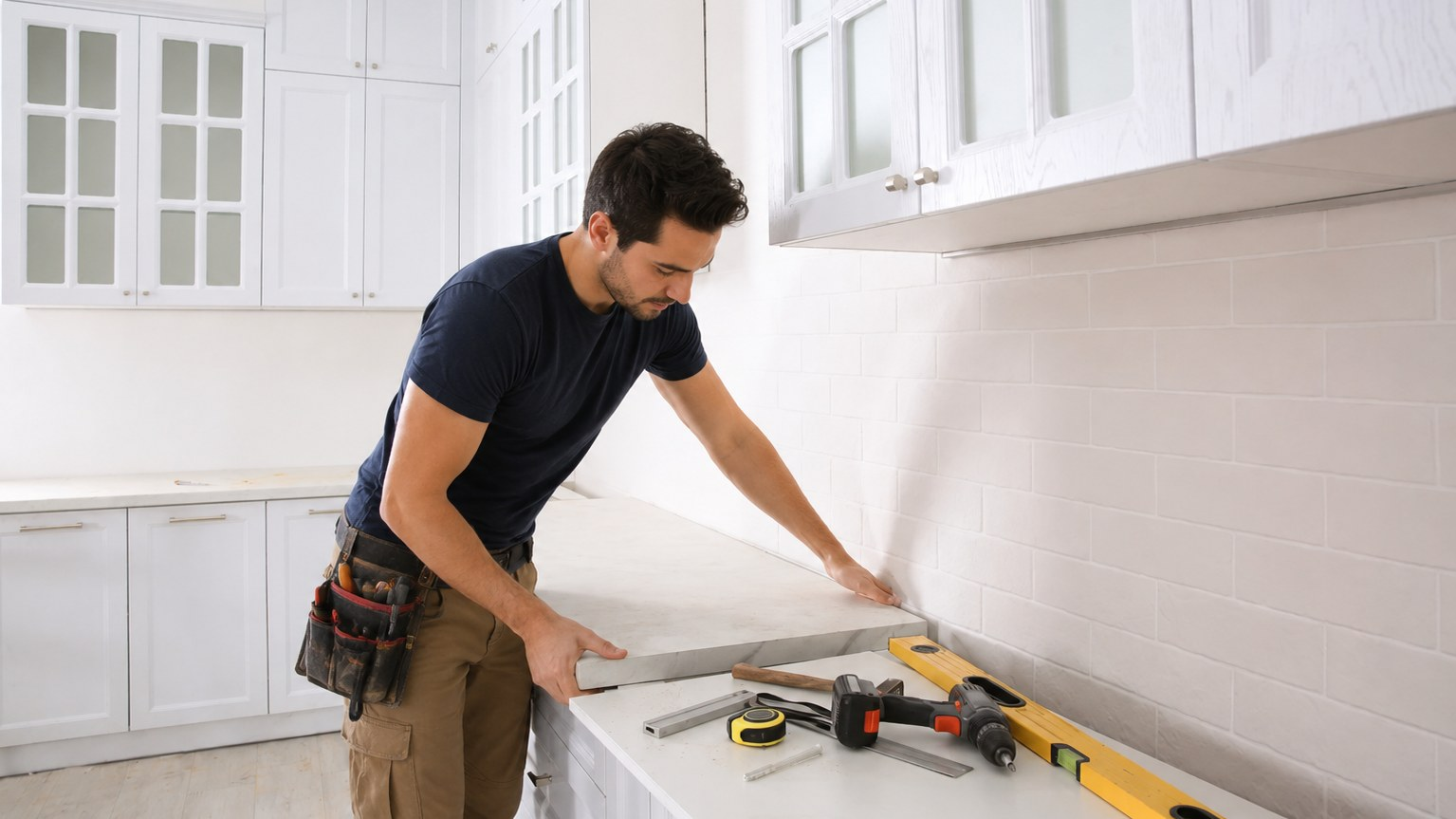
Stone is unforgiving. A slab bridging a dip in the cabinet run bears on two points instead of along its length, and that concentrates stress exactly where a crack will start. So the first thing we do is shim the cabinets to a true plane, checked across the full run rather than box by box, and only then take the template. If a cabinet is racked badly enough that shimming will not fix it, we tell you before we quote.
Scribing to a wall that is not straight
A scribe means transferring the actual wall profile onto the stone and cutting the slab edge to follow it. On a plaster wall from 1910 that profile can wander noticeably across eight feet. Digital templating captures the real line instead of assuming a straight one, and the back edge comes off the saw already matching it. The alternative, filling a wandering gap with caulk, looks exactly like what it is.
| What we find in an older Elgin kitchen | Why it matters for stone | How we handle it |
|---|---|---|
| Cabinet run falling end to end | Slab bears on high points and can crack | Shim to a true plane, then template |
| Bowed or wandering plaster wall | Gap opens behind a straight-cut edge | Digital scribe, or full-height backsplash |
| Corners well off square | Mitered corners will not close | Template the real angle, cut to it |
| Original cabinets with weak tops | Cannot carry three centimeter stone alone | Add plywood substrate or steel support |
| Brick or masonry return wall | Nothing to fasten a backsplash into | Adhesive set with mechanical relief |
| Old plumbing in the sink base | Undermount depth may not clear the trap | Confirm clearances before cutting |
Commercial Tops for Smokehouses and Restaurants
Elgin has been the Sausage Capital of Texas since 1995, and the food businesses that earned it that name need work surfaces built for volume rather than for photographs.
Commercial specification differs from residential in three ways. Sanitation comes first, which means non-porous surfaces and seams that are genuinely sealed rather than merely tidy. Second is impact and heat, since a back-of-house prep surface takes abuse a home kitchen never sees. Third is downtime, because a restaurant losing its prep line loses its week.
Brick, Plaster and the Realities of a Historic Remodel
The brickyards that made this town left their mark on its buildings, and both brick and original plaster behave differently from modern drywall when you start attaching things to them.
Plaster over lath cracks if you fasten aggressively into it, and it is rarely flat. Brick will not take a standard anchor in the mortar joint reliably. Neither is a reason to avoid stone, but both change how a backsplash gets mounted and how much relief a slab edge needs so seasonal movement does not push against something rigid.
We also allow for what is behind the surface. Older sink bases hold plumbing that was never meant to accommodate an undermount bowl, and drop-in fixtures sometimes hide a cut that a new template will expose. Checking trap clearance and the condition of the base before cutting is a five minute job that prevents a genuinely bad afternoon.
Preserving Original Character While Replacing the Working Surface
Choices that read as period-appropriate
Honed rather than high-polish finishes sit far more quietly in an old house. Soapstone is a strong choice, dark and soft-looking and completely non-porous, and it darkens with oiling into something that suits a room with age in it. Simple edge profiles read better than heavy ones. An eased or slightly beveled edge belongs; a large ogee usually fights the cabinetry.
The town has kept its own character the same way. The Dr. I. B. Nofsinger House now serves as city hall, the original 1872 railroad building still stands, and the Julius Woeltz mural Texas Farm is still on the post office wall. Old things stay useful when somebody maintains them properly.
{{LEAD_FORM:mid}}
Our Range East of Austin on US 290 and SH 95
Elgin sits twenty five miles east of downtown Austin where US 290 and SH 95 cross, which puts it comfortably inside the radius we cover daily. The historic downtown around the 1872 railroad building is where a lot of our restaurant and small commercial work sits.
Running back west on US 290 we are in {{LINK:location:manor}} several times a week. North of the highway we cover {{LINK:location:hutto}} and {{LINK:location:pflugerville}}, and further up the corridor we reach {{LINK:location:georgetown}}. If you are further out into Bastrop County than the map suggests, call and ask, because the answer is usually yes. Our {{LINK:archive:location}} page lists everywhere we serve.
Other Services We Provide in Bastrop County
Restaurants, smokehouses and small food businesses are handled under {{LINK:service:commercial-countertop-installation}}, scheduled around service hours. Rooms with irregular geometry usually call for {{LINK:service:custom-countertop-fabrication}}, since a stock piece will not fit a wall built in 1910. Failed joints in an existing top fall under {{LINK:service:seamless-countertop-joining}}, and chips, cracks and worn spots under {{LINK:service:countertop-repair}}, which often saves an otherwise sound surface.
Materials That Suit an Older Elgin Kitchen
{{LINK:material:soapstone}} is our most frequent recommendation in a period house: non-porous, quiet in tone, and better looking after ten years than on day one. {{LINK:material:granite}} in a honed finish gives real durability without a showroom shine. {{LINK:material:quartz}} is the practical answer when the kitchen has to be easy rather than characterful, and it never needs sealing. {{LINK:material:marble}} suits a baking counter or a vanity if you welcome a patina, and {{LINK:material:slate}} offers a matte, dense surface that sits comfortably against old woodwork.
To get an estimator out to look at the actual room, start from {{LINK:home}} or call {{PHONE}} and we will find a time that works.
Historic Home and Restaurant Answers in Elgin
Can you fit new countertops to walls built in 1910?
Yes, and it is routine work for us. We digitally template the real wall profile rather than assuming a straight line, then cut the slab’s back edge to follow it. Where a wall wanders too far to scribe cleanly, a full-height backsplash absorbs the difference. Either way we identify the issue at the estimate, not on install day.
How do you handle cabinets that are out of level?
We shim them to a true plane before templating, checking with a long level across the entire run rather than box by box. This matters more with stone than with laminate, because a slab bridging a dip bears on two points and concentrates stress where a crack starts. If a cabinet is racked beyond shimming, we tell you before quoting.
Do you do commercial tops for restaurants?
We do, including prep surfaces, service counters and bar tops. Commercial work is specified for sanitation and impact rather than appearance alone, with genuinely sealed seams and non-porous surfaces. We schedule around service, usually overnight or on a closed day, and fabricate everything before the existing tops come off so the line is not down longer than necessary.
Do you serve Bastrop County?
Yes. Elgin straddles Bastrop and Travis Counties and we cover the area on both sides of that line, working the US 290 and SH 95 corridors regularly. If your address is further out into the county than you would expect us to travel, call and ask anyway, because the answer is usually yes.
Can you preserve the original look of a historic kitchen?
That is normally the goal. Honed finishes sit far more quietly in an old room than high polish, simple eased or beveled edges suit period cabinetry better than heavy profiles, and soapstone or honed granite reads as belonging rather than as an insertion. We template to your existing cabinetry rather than asking you to replace it.
Is the on-site estimate free?
It is, and in an older house it is the only estimate worth having. We come out, level the run, check the walls for bow and the corners for square, look at the sink base plumbing, and give you a written scope with no charge and no obligation. Photographs cannot tell you what a hundred year old kitchen is actually doing.
How far east do you travel?
Past Elgin and into Bastrop County comfortably. US 290 and SH 95 are roads we run constantly, and a job further out is a scheduling question rather than a refusal. Give us the address or the nearest crossroads when you call {{PHONE}} and we will confirm coverage and a likely window on the same call.