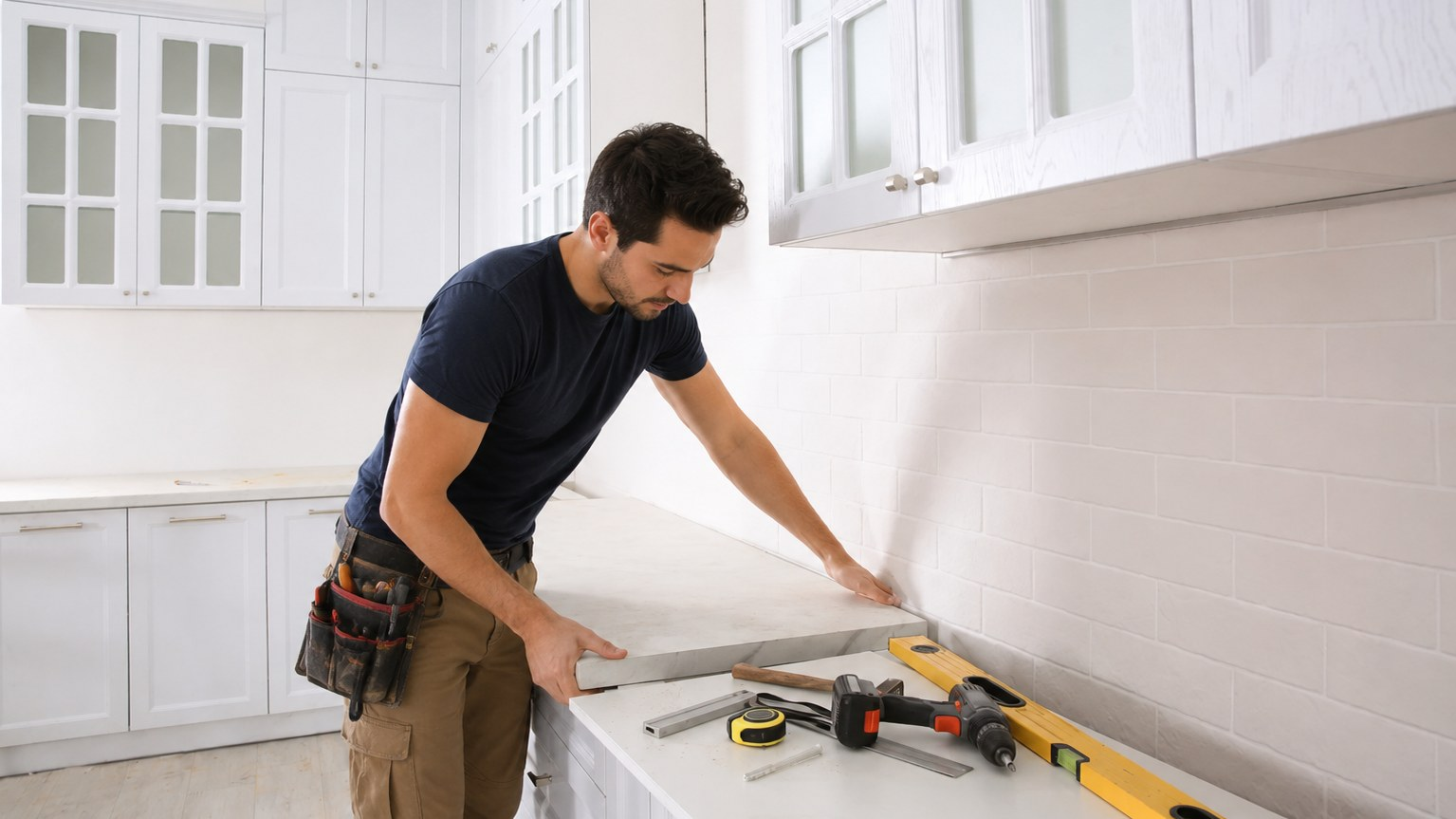
In-House Fabrication: CNC Cutting, Waterjet and Hand Finishing
Natural stone is cut and finished at fabricator shops with hand routers, grinders or CNC machinery, and the balance between those three decides how a piece turns out. Straight rips, cutouts and repeatable profiles go to the machine because a machine holds a line better than a person can. Inside corners, polished reveals and anything sculptural go to a fabricator with a grinder and thirty years of muscle memory.
Waterjet handles the work a blade cannot, cutting tight radii and inside corners without the stress fractures a plunging blade leaves behind. On engineered quartz, cut parts cure for 24 to 48 hours before final polishing. On natural stone we polish through a full grit sequence so the edge sheen matches the factory face rather than sitting slightly duller beside it.
Digital Templating With a Laser Measure Beats Cardboard Every Time
Cardboard templates absorb humidity, flex on the drive back to the shop and record whatever the person cutting them decided a corner looked like. A laser template records the room as points in space, captures walls that lean and corners that are not 90 degrees, and produces a file the CNC reads directly. Nothing is redrawn by hand, so nothing gets lost in translation.
The template session captures more than outlines. Wall bow, cabinet height variance, appliance locations, the exact model of your sink, the faucet hole positions and the overhang you want are all recorded in one visit. Full detail on that appointment lives under {{LINK:service:countertop-templating-and-measurement}}.
The payoff shows up on install day. A properly templated piece drops in, the scribe against the back wall is already cut, and the crew is not standing in your kitchen with a grinder trying to make stone fit a wall that was never straight.
Mitered Edges and Waterfall Panels That Carry the Vein Around the Corner
A mitered edge is two pieces cut at 45 degrees and bonded into an apron, so a 20mm slab can read as a thick monolithic block. Done badly, the joint shows as a pale line and the pattern jumps at the corner. Done properly, the vein runs off the top surface and continues down the face as if the stone were solid all the way through.
That continuity is a layout decision made before cutting. We nest the apron pieces immediately adjacent to the deck piece on the slab, mark the direction, and dry fit the assembly in the shop with the vein aligned. Waterfall islands take the same logic further, carrying the pattern over the end of the island and down to the floor in one visual line.
Miters need support underneath and a clean substrate. We build the internal framing as part of the fabrication rather than leaving it to the site crew to improvise.
Radius Cuts, Curved Bar Tops and Angled Peninsulas
Curves are where fabrication ability shows. A radius bar top has to hold a consistent arc, keep the edge profile identical the whole way round, and land on cabinetry that was probably built to a slightly different curve. We cut the arc on the machine from the template file, then hand finish the edge so the profile does not thin out at the ends.
Angled peninsulas, splayed islands and eased corners all get the same treatment. Any inside corner in stone is a stress point, so we radius them rather than cutting a sharp 90, which is the single most common cause of a crack appearing weeks after install.
Cutouts follow the same care. Openings for cooktops, downdrafts and undermount sinks all get radiused corners and, where the span is tight, a rodded or reinforced deck. {{LINK:service:appliance-cutouts}} covers the clearance rules manufacturers actually require.
Slab Layout: Where We Put the Seam and Why
Slabs are finite, so seams exist. The craft is in choosing where. A seam wants to land where the stone is supported, where the eye does not linger, and where the pattern can be matched credibly. Sink decks, inside corners and the transition into a cooktop cutout are all good candidates. The middle of an open island is not.
We show you the seam plan over a photograph of your actual slab before cutting, so there are no surprises on install day. Where the material has strong directional movement, we sequence adjacent pieces from the same bundle so the vein continues across the join. Bonding, color matched epoxy and level setting are covered under {{LINK:service:seamless-countertop-joining}}.
Long runs sometimes force a choice between one seam in a visible place and two in hidden ones. We lay out both options and let you pick rather than deciding quietly on your behalf.
Turnaround From Template to Install
Most residential jobs run about one to two weeks from template to install, and every stage in between has a reason to exist. Rushing any of them is how a shop ends up remaking a piece.
| Stage | What happens | Where | What you do |
|---|---|---|---|
| Laser template | Room captured as a digital file, options confirmed | Your home | Have sink, faucet and cooktop on site |
| Layout approval | Cut list dropped over slab photos, seams agreed | Shop or by email | Approve the seam and vein plan |
| Machining | CNC and waterjet cutting, cutouts, edge profiling | Our shop, wet cut | Nothing |
| Finishing | Grit sequence polishing, dry fit of mitered assemblies | Our shop | Nothing |
| Install day | Tear out, set, seam, seal, silicone and cleanup | Your home | Clear the cabinets and keep pets away |
| Plumbing reconnect | Sink and disposal reconnected once silicone cures | Your home | Avoid heavy use for a day |
Materials We Cut and Finish
Different stones want different tooling, and we set the shop up accordingly. {{LINK:material:quartzite}} is punishing on blades and rewards patience, {{LINK:material:porcelain}} and {{LINK:material:sintered-stone}} need slow feeds and support to avoid chipping at the exit, {{LINK:material:solid-surface}} is thermoformed and sanded to invisible joints, and {{LINK:material:terrazzo}} or {{LINK:material:recycled-glass}} bring their own polishing requirements.
Fabrication for the Whole Austin Metro
We fabricate and deliver to {{LINK:location:cedar-park}}, {{LINK:location:dripping-springs}}, {{LINK:location:buda}}, {{LINK:location:manor}}, {{LINK:location:elgin}} and {{LINK:location:hutto}}, plus every district inside the city. Builders running multiple addresses should look at {{LINK:service:commercial-countertop-installation}}. Ready to move? See the full scope of what we build on {{LINK:home}}, then call {{PHONE}} to get your drawings priced this week.
{{LEAD_FORM:mid}}
Fabrication Questions
Can you fabricate from a slab I already bought?
Yes. Client supplied slabs are common, and we handle them regularly. We inspect the material first for existing fissures, resin backing and thickness variation, and we tell you what we see before we cut. Once we take custody we treat it as our own. The inspection happens before any commitment so nobody is surprised later.
How long does fabrication take after templating?
Typically one to two weeks for a residential kitchen. Machining and cutouts are quick, but edge polishing, dry fitting mitered assemblies and, on engineered quartz, allowing cut parts to cure for 24 to 48 hours before final polish all take real time. Complex waterfall or curved work adds a few days. You get a firm install date at layout approval.
Can you match an existing countertop in another room?
Sometimes. Natural stone varies from lot to lot, so an exact match to a slab cut years ago is rarely possible, though we can often find a close relative at the yard. Engineered quartz is easier if the product is still in production, since we can order the same code and check the lot. Bring us a photograph and a corner sample.
Do you fabricate curved and radius countertops?
We do. Curved bar tops, radius peninsulas, eased corners and splayed islands are all cut from the template file on the machine, then hand finished so the edge profile stays consistent through the arc. We also radius inside corners on every cutout, because a sharp inside corner in stone is the most common origin point for a later crack.
What file formats do you accept from a designer or architect?
Standard CAD and vector drawings work well, and dimensioned PDF plans are perfectly usable for quoting. We still laser template on site before cutting, because drawings describe the design intent and a template describes the room as built. Send whatever you have and we will tell you what else we need to produce an accurate scope.
Can you do a mitered waterfall island?
Yes, and it is one of the pieces we most enjoy building. The panels are nested next to the deck piece on the slab so the vein carries over the corner and down to the floor, the 45 degree joints are dry fitted in the shop, and internal support is built as part of the assembly rather than improvised on site.
Who is responsible if a slab breaks during fabrication?
If a slab we supplied breaks in our shop or in transit, we replace it and absorb the delay. That is what being fully insured and bonded means in practice. For client supplied material we document any pre-existing fissures or resin repairs at intake, agree the risk in writing before cutting, and handle it with the same care as our own inventory.
How do I get a fabrication quote?
Send your plans, sketches or a rough sketch with dimensions through the form on this page, or call {{PHONE}} and describe the scope. We will review the drawings, flag anything that affects feasibility, and schedule a free on site measure so the written quote reflects the actual room rather than an assumption.