
Vanity tops and bathrooms
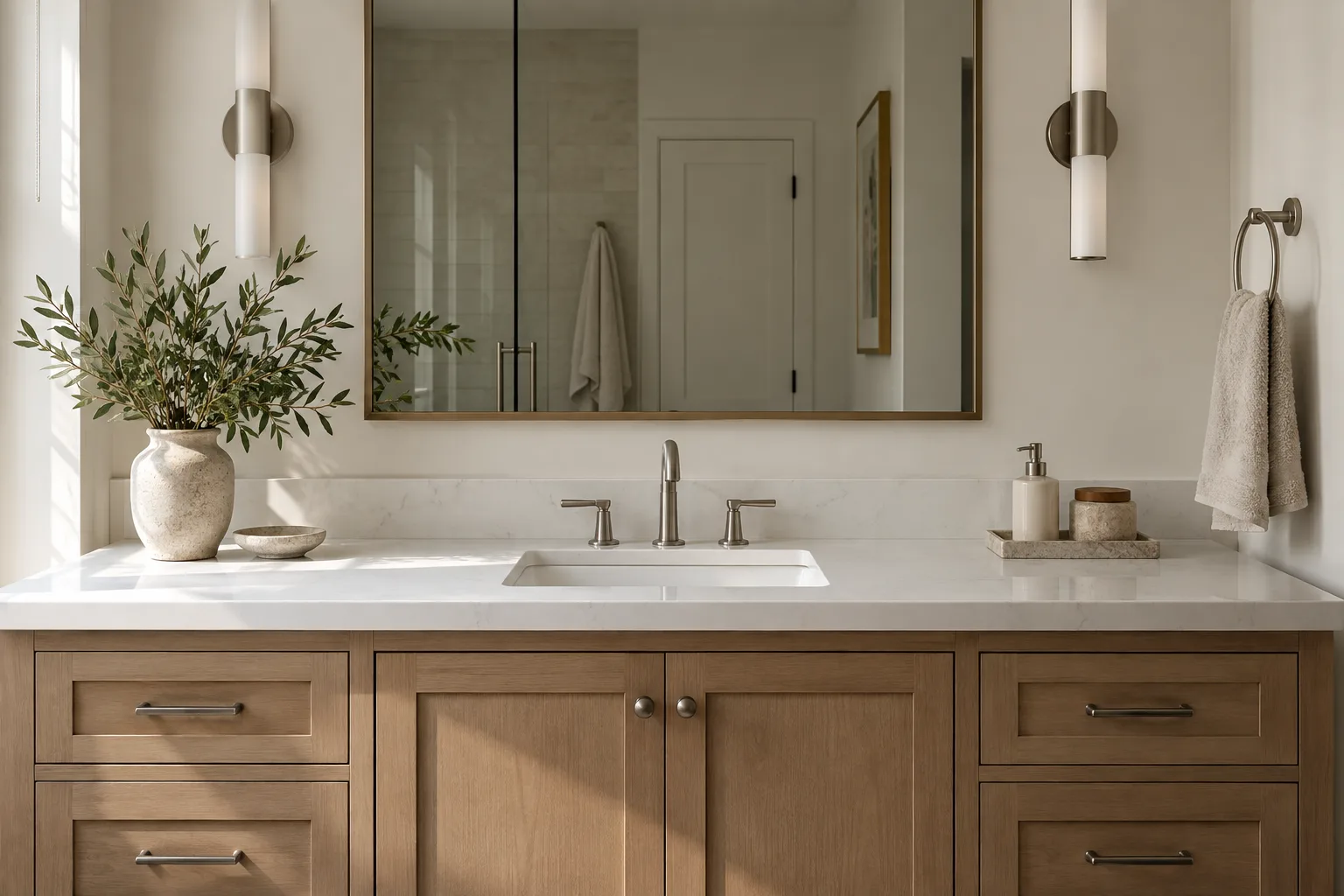
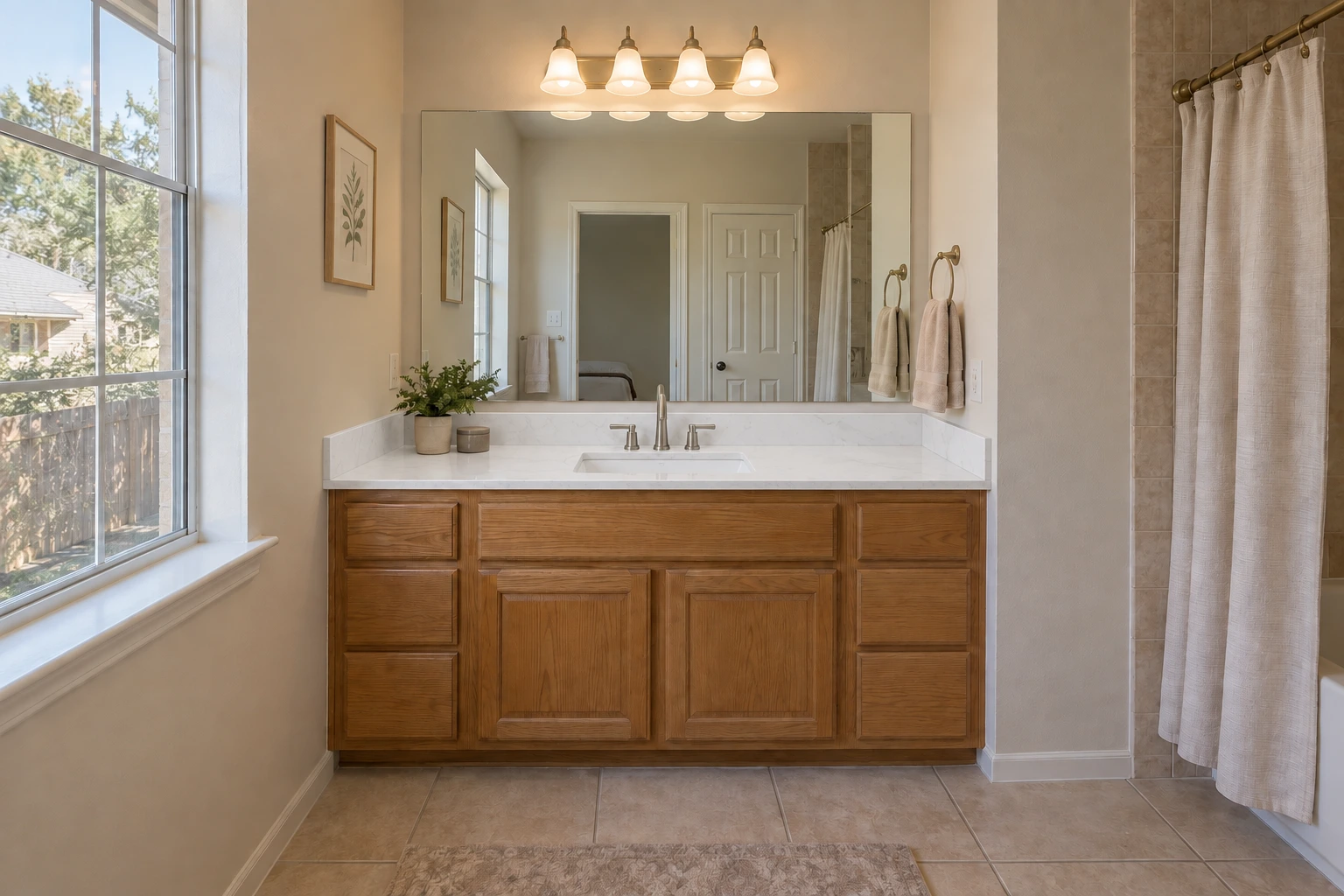
The best use. Little acid exposure, and the material is on show constantly. This is where marble earns its price.
Austin · West Lake Hills · Rollingwood · Barton Creek · Lakeway
Austin Custom Countertops is the shop behind marble countertops in Austin, TX, and is Travis County's specialist in metamorphic carbonate stone, specializing in 3 cm marble countertop fabrication for kitchens, cored inside corners at sink openings, and rodded front rails where the stone runs narrow. We offer honed surfaces, which carry an etch far more quietly than a polish does, and vanity tops in Carrara, Calacatta and Statuario.
Request a FREE Quote!
Our team provides a plain explanation of etching before you commit, because acid dissolves a microscopically thin layer of calcite and no sealer prevents that, delivering marble countertops chosen with open eyes for homes and specification grade stonework for both residential and commercial projects. We lay your slab out with you standing at the table, cut it on our own CNC in our own Austin shop, and the same crew sets the countertops and warrants the seams in writing.
From a poultice that draws an olive oil stain back out of the pore structure to a honed island that is allowed to wear its etching as patina instead of fighting it, our team handles every detail. Serving homes in Austin, Barton Creek and West Lake Hills, we would rather talk you out of a polished marble island you will resent than fit one and let you discover the first lemon ring on your own.
Marble is a metamorphic rock. It begins as limestone or dolostone, a carbonate sediment, and heat and pressure recrystallize it into the interlocking crystal texture you see on a finished slab. The main minerals are calcite, which is calcium carbonate, and in some quarries dolomite, which is calcium magnesium carbonate. The veining is not printed or applied. It is the impurities that were already in the sediment, clay, sand, iron oxides and chert, mobilized and recrystallized by the metamorphism. That is why the pattern runs through the full thickness of a marble countertop instead of sitting on top of it, and why two slabs off the same block still differ.
Two properties follow directly from that composition, and between them they explain almost everything a marble countertop will ever do. Calcite sits around 3 on the Mohs hardness scale and dolomite is only a little harder, roughly 3.5 to 4. Quartz, the grit that gets tracked across a floor and onto a counter, sits at 7. A steel knife blade is harder than both carbonate minerals. The second property is that carbonate reacts with acid. Drop acid on calcium carbonate and it releases carbon dioxide and calcium ions and takes a thin layer of the stone with it. That is the same reaction that hollows limestone caves under the Hill Country west of Austin, running at kitchen scale and kitchen speed.
Buyers use these two words as if they were one problem. They are not, they have different causes, and only one of them can be prevented.
Etching is acid attack on the surface. Lemon, lime, vinegar, wine, tomato, some fizzy drinks and a lot of household descalers and bathroom cleaners are acidic enough to do it. The acid dissolves a microscopically thin layer of the stone, and what is left behind is a dull spot where the surface used to reflect light. Nothing has been added to the countertop. Something has been removed from it. On a polished marble countertop that shows up fast, because a matte ring against a glossy field is easy to see.
Staining is absorption. A pigmented or oily liquid soaks into the pore structure and colors the stone from below. Olive oil, red wine and turmeric are the usual offenders. A stain usually takes hours rather than seconds, and it can often be drawn back out with a poultice.
Here is the part most showrooms skip. A sealer does not stop etching. An impregnating sealer lives in the pores and slows absorption, which is a stain defense. Etching happens above it, on the surface itself. No sealer, no coating and no sales pitch changes that, because the reaction is chemistry rather than a defect. If you cook with citrus and cannot live with a countertop that records what happened on it, marble is the wrong material for your kitchen. We would rather say that at the slab yard than fit it and hear about it in March.
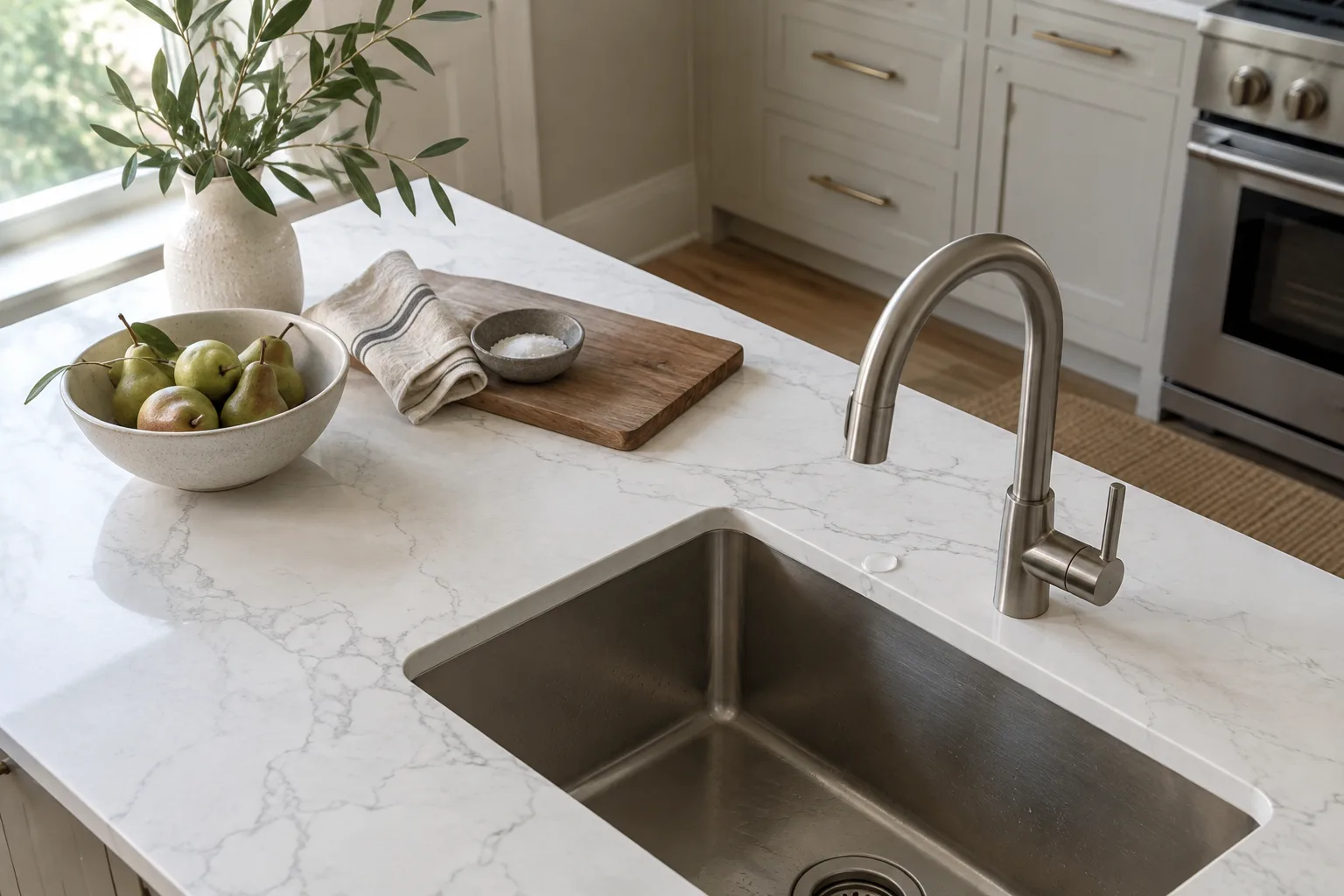
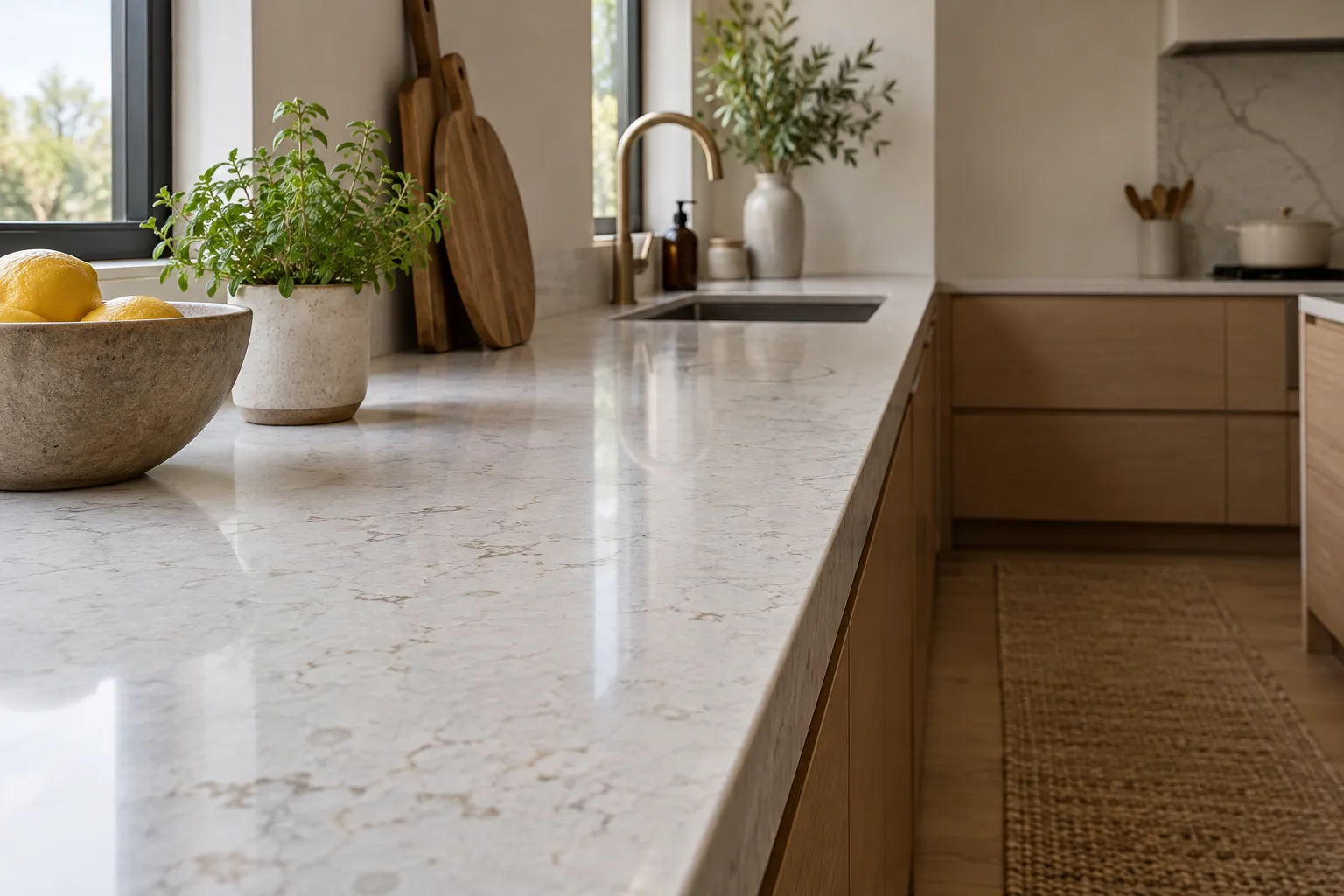
The finish you pick changes how much of the above you actually notice. Polishing closes the pores, so a polished marble countertop absorbs less and frequently needs little or no sealer, but it shows every etch mark as a dull patch. Honing leaves the surface matte. It is more absorbent, so it takes a sealer more readily and wants one, and in exchange an etch mark has almost nothing to contrast against. Leathered and brushed finishes work on the same logic. For a working Austin kitchen, honed is the finish that ages most gracefully, and plenty of owners stop noticing individual marks at all and start calling the overall softening a patina.
Austin water is worth planning around. The Colorado River and the Highland Lakes run over and through Hill Country limestone, and the Edwards Aquifer dissolves calcium carbonate straight into the supply, so what comes out of the tap is hard and mineral rich. Hard water leaves chalky deposits around faucets and undermount rims, and the products sold to remove those deposits are almost all acidic. Reaching for one is the single fastest way to etch a marble countertop. Blot spills, wipe standing water off the deck area, and use a pH neutral stone cleaner only.
To decide whether a marble countertop needs resealing, test it rather than diary it. Put a few drops of water in several spots, leave them fifteen to twenty minutes, then wipe. If the stone darkened underneath, it is absorbing and it is time. If it did not, sealing it again achieves nothing.
Carrara comes out of Italy and is the quiet one, a white to blue gray ground with soft feathery gray veining. Calacatta has a whiter background with fewer, thicker, higher contrast veins, which makes it read as a much bolder countertop in the same square footage. Statuario is brighter white again with dramatic gray movement. Thassos, from Greece, is close to pure white with essentially no veining at all, which is a very different design problem because there is no pattern to hide behind.
Vermont Danby is the one worth knowing about if etching worries you. It is quarried underground in Rutland County from an Early Ordovician dolomite unit, which makes it a dolomitic marble rather than a calcite one. Dolomitic marbles generally absorb less water and stand up to acid slightly better. Slightly better is not immunity, and it will still etch, but the margin is real.
One caution on names. A marble trade name describes a quarry region and a general look, not a graded performance standard. Two slabs sold under the same name, cut from different blocks, can differ in vein density, background tone and porosity. We look at the specific slab you are buying, and we look at it with you.
We laser template off your actual cabinets once the old tops are out, so the measurements come from the room as built rather than from a drawing of it. Cabinets are rarely square and walls in older Austin houses are rarely straight, and a digital template records the reality instead of averaging it.
Then comes slab layout, which is where a marble job is won or lost. We mark on the slab where each piece falls, and you are welcome to stand at the table while we do it. That is the conversation that decides whether the best vein lands across the island or gets consumed by a sink cutout, where the seam sits, and whether the pattern runs continuously around a mitered edge or stops dead at the corner.
Cutting happens on our CNC in our own Austin shop. We build kitchen marble countertops in 3cm as a default, because marble is softer and more brittle than granite and the extra mass tolerates blade vibration without starting micro fractures at the cut edge. A 2cm countertop needs a substrate under it and wants a rodded or reinforced front rail at an undermount sink. Inside corners on sink cutouts get cored rather than turned square, because a square inside corner is a stress riser and stress risers are where stone cracks later. Narrow runs in front of and behind a sink get rodded. Seams are cut to meet tight and set with color matched epoxy.
Our own crew installs. Nobody is subcontracted, which means the people who cut the stone are the people accountable for how it sits on your cabinets, and the price you were quoted is the price.
We do not publish a per square foot number, because a real marble countertop price is decided by the specific slab and the specific kitchen. What we can do is tell you exactly which levers move it, so you can see your own quote coming.
Square footage is the base. More surface means more material, more machine time and more weight to carry, and it usually also means more pieces, which brings its own costs.
Material grade and rarity is the biggest swing. Marble is quarried, not manufactured, so a block with a rare background tone or unusually clean white ground is priced by scarcity. Carrara and a premium Calacatta are the same mineral doing very different things to a supplier's inventory.
Slab movement and layout difficulty costs labor before anything is cut. A heavily veined slab has to be laid out deliberately, and on a highly figured stone we may have to waste material to put the right pattern in the right place. That waste is real material you are paying for.
Book matching, where two sequential slabs are opened like a book so the veining mirrors across a seam or up a backsplash, requires both slabs from the same block, precise sequencing, and cutting that has no second chance. It is one of the most expensive things you can ask a fabricator to do, and one of the most striking.
Edge profile changes machine time. A straight eased edge is fast. An ogee, a bullnose or a double profile takes more passes and more hand polishing. A mitered edge that makes 3cm read as a thick slab is effectively building an extra part and wrapping the vein around it.
Cutouts each carry labor and risk: sinks, cooktops, faucet and soap holes, pop up vents. Undermount cutouts also need the exposed edge polished, because it is visible for the life of the countertop.
Seams cost money and sometimes save it. Seam count is driven by slab size against your layout, and by how far the finished pieces can physically travel through your house. Fewer seams often means bigger, heavier pieces and more crew.
Thickness matters because 3cm is more material than 2cm, though 2cm claws some of it back in substrate build and extra install time. Removal of the old countertop is its own line. Tearing out tile set in mortar is a different job from lifting a laminate top, and if a slab is bonded to cabinets or a backsplash is tied into the wall, demo takes longer and repairs follow it.
The best use. Little acid exposure, and the material is on show constantly. This is where marble earns its price.
Two consecutive slabs opened like a book so the veining mirrors. Dramatic, and entirely protected from kitchen use.
Workable if you accept a patina. Honed marble hides etching far better than polished, because a matte surface has nothing to dull.
The hardest place to keep it. If this is the run you care about, we would steer you to quartzite, which looks similar and behaves like granite.
We will fit it in a kitchen if you want it, and we will tell you plainly what it will look like in five years. In a primary bathroom, on a vanity, or as a bookmatched feature wall, it is a different proposition: far less acid exposure, and it stays looking the way it did on day one.
We laser template off your cabinets and confirm sink, cooktop and overhang details in about an hour.
You choose your actual slab rather than a sample chip, so the movement and veining you approve is the one that gets installed.
Cut, edged and polished in our Austin shop, typically five to ten working days from template.
Old tops out, new tops set and seamed, sink and cooktop refitted. Most kitchens finish in a day.
Mostly the slab itself, then the layout. Rarity and background clarity price the material, heavy veining forces deliberate layout and waste, and book matching multiplies both. After that it is square footage, seam count, edge profile, number of cutouts, thickness and what has to come out first. We walk through every one of those on your quote rather than handing you a number with no reasoning attached.
Template happens once the old countertops are out and the cabinets are set and level. Fabrication follows in our shop, and install is typically a single day for a normal kitchen. The variables that stretch the timeline are slab availability, whether the stone has to come in from a distributor, book matching, and any plumbing or electrical work that has to be scheduled around us. We give you dates and we tell you when one of them moves.
You lose the use of your sink and cooktop from demo through to the plumber's return, which is usually a couple of days rather than a couple of weeks. Cutting is done in our shop, not in your house, so the on site work is demo, set, seam and seal. There is dust from removing the old tops and there is noise, and both are contained to the demo phase.
Yes. Not maybe. Any acidic liquid that sits on calcite or dolomite will dissolve a thin layer of the surface and leave a dull mark. Lemon, vinegar, wine, tomato and many household cleaners all qualify. A honed finish makes the marks very hard to see, and most owners find the surface settles into an even patina, but nobody should buy marble countertops believing the first etch will not arrive.
Staining, yes, partly. Etching, no. A sealer is an impregnator that sits inside the pores and slows down how fast liquids soak in, which buys you time to wipe up oil or wine before it discolors the stone. Etching happens at the surface, above the sealer, so the sealer is not in the reaction at all. Any product marketed as an etch proof sealer for marble is claiming something chemistry does not allow.
Usually. A poultice draws the absorbed material back out of the pore structure, and oil based stains respond well to it, though it can take more than one application. Etch marks are a different repair entirely, because there is stone missing rather than something added. Light etching on a honed surface can often be blended back in. Deep etching on a polished surface needs the area repolished.
Engineered quartz is the low maintenance choice, non porous and acid resistant, but the pattern is manufactured and a truly convincing vein is hard to get. Granite is a silicate, much harder than marble and unbothered by acid, so it wins on pure durability while offering a completely different look. Marble is the one you choose because nothing else looks like real marble, and you accept that it is a soft, acid sensitive stone in exchange. Buying marble expecting quartz behavior is the mistake we see most.
The failures we see are etch rings from citrus and cleaners, scratches from cutting directly on the stone, dark absorbed rings under oil bottles, and cracks where a narrow run in front of a sink was never rodded or where cabinets were not shimmed level. Most of those are preventable. If your household cooks heavily with acid, leaves spills for later, or simply wants a surface that looks identical in five years to the day it went in, marble is the wrong material and we will say so before you pay a deposit. Quartz or granite will make you happier.
Free measure across Austin and the surrounding Hill Country. No obligation, and no add-ons at install.
Calls only, we do not receive text messages.