
The acid test
A drop of acid on an offcut. True quartzite is unaffected. If it dulls, the slab is dolomitic and will etch like marble in a kitchen.
Austin · West Lake Hills · Rollingwood · Barton Creek · Lakeway
Austin Custom Countertops builds quartzite countertops in Austin, TX, and is Travis County's specialist in hard metamorphic stone, specializing in slab verification before purchase, quartzite countertop fabrication in 3 cm, and diamond tooling matched to a rock that fractures through its grains rather than around them. We offer scratch and acid spot testing on the slab you are considering, and petrographic examination to ASTM C1721 when the answer is still not clear.
Request a FREE Quote!
Our team provides an honest verdict on stone sold under the wrong name, because a great deal of what is labelled quartzite is dolomitic marble and will etch the first time a cut lemon rolls off a board, delivering quartzite countertops that genuinely resist acid for homes and hard wearing surfaces for both residential and commercial projects. We cut wet in our own Austin shop, because this rock approaches pure silica, and the crew that templated your kitchen sets the countertops under a written warranty.
From a glass scratch test taken on the corner of a slab you have not paid for yet to a full kitchen and island cut from a stone harder than granite, our team handles every detail. Serving Austin, Rollingwood and Lakeway, we test the rock before the money moves rather than after it is bonded to your cabinets.
Quartzite is metamorphosed sandstone. The protolith is a clean quartz sand, and regional metamorphism, the kind of heat and pressure that builds mountain belts, welds those grains together and recrystallizes them into an interlocking mosaic of quartz crystals. The original sedimentary bedding is largely erased in the process. What is left is a non foliated rock that is close to pure silica, with pure examples approaching 99 percent silicon dioxide and only trace iron oxide, zircon, rutile and magnetite riding along.
There is a diagnostic that geologists use and it tells you something useful as a buyer. Sandstone breaks around its grains, because the weak point is the cement between them. Quartzite breaks through the grains, giving an irregular or conchoidal fracture, because after metamorphism there is no cement left that is weaker than the quartz itself. The rock has become one continuous thing. That is why a true quartzite countertop is hard, why it resists chemical weathering so well, and why it is the stone left standing as ridges when everything softer around it has eroded away.
The number that matters is 7. Quartz sits at 7 on the Mohs hardness scale. Common household grit is quartz, a steel knife is around 5.5, and glass is about 5.5 too. A real quartzite countertop is harder than the things that would normally scratch a counter.
This is the most useful thing on this page, so read it before you go slab shopping.
Quartzite is the most misrepresented material in the countertop trade. Slabs sold under the quartzite label range from genuinely among the hardest natural stones available to soft, porous dolomitic marbles that etch and stain exactly like a piece of Carrara. Both look like a white stone with gray veining under showroom lighting. One of them survives a family kitchen without thinking about it. The other one records every lemon.
The reason the confusion persists is partly geological and partly commercial. There is a real continuum in nature between a quartz sandstone, a partly metamorphosed quartzite and a fully recrystallized one, and separately there are carbonate rocks that were never quartz at all and simply resemble it. Dolomitic marble is metamorphosed dolostone, made of calcium magnesium carbonate, and the dolomite mineral is Mohs 4 or less. That is roughly half the hardness of quartz and, more importantly, it is a carbonate, which means acid dissolves it. Super White is the best known example of a name that gets sold as quartzite and very often is not. Names like Taj Mahal, Mont Blanc, White Macaubas, Cristallo and Sea Pearl describe a quarry region and a look. None of them is a graded performance standard, and none of them guarantees what is in the slab in front of you.
Nobody has to be lying for this to happen. A name travels with a container from a quarry through a distributor to a showroom, and no one along that chain is required to test it. We test it.
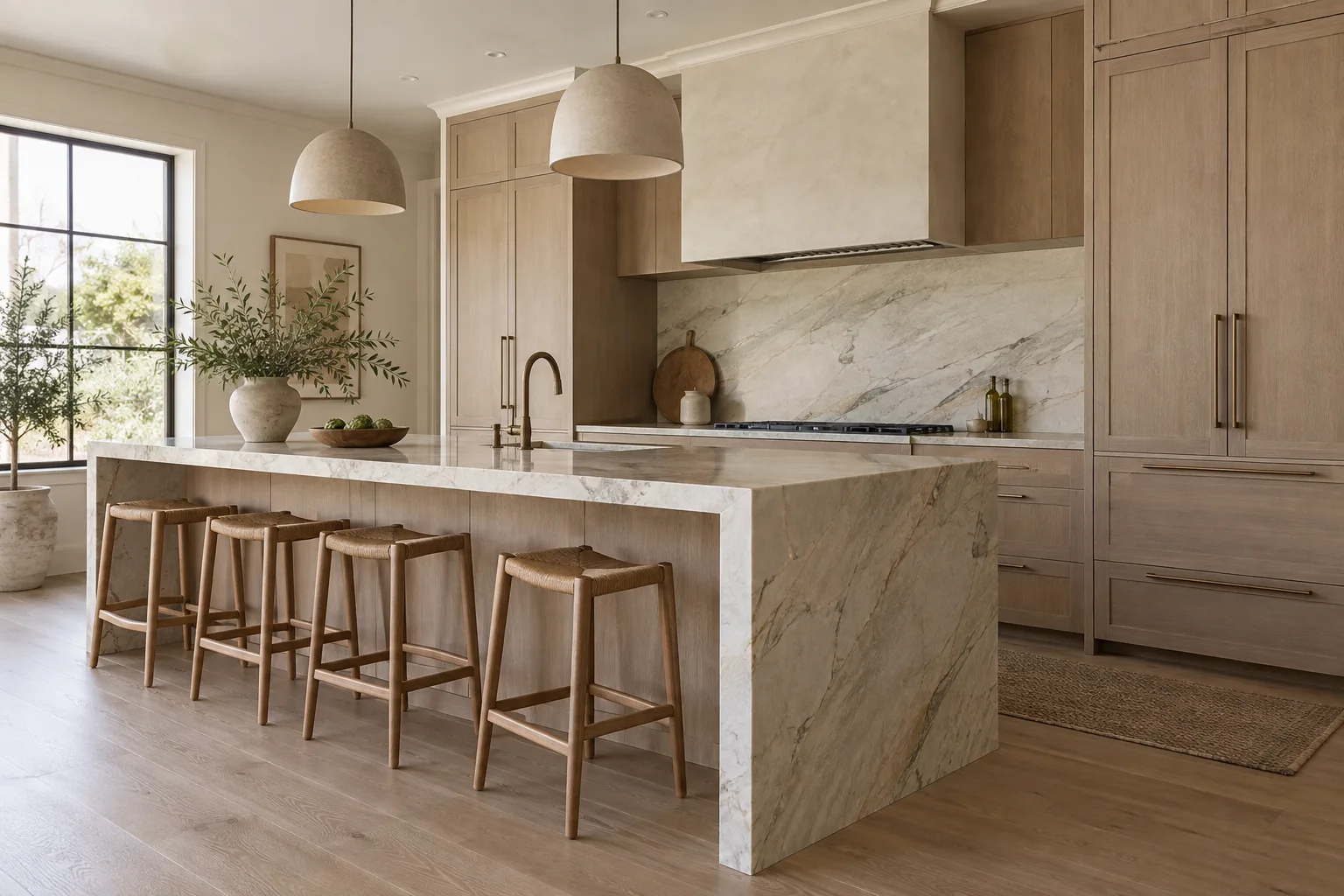
Two tests answer the question, they are cheap, and they take under half an hour.
The scratch test uses hardness. Quartz is 7 and glass is about 5.5, so a broken chip or corner offcut of true quartzite dragged firmly across a piece of glass or an old mirror leaves a clear, permanent scratch in the glass. A dolomitic marble at 3.5 to 4 will not scratch glass. It will get scratched by it. Run the test with a sample the yard has broken, not by scraping the face of a slab you might buy.
The acid test uses chemistry, and it is the one that matters most, because etching is the failure buyers actually regret. Put a small amount of lemon juice or white vinegar on an inconspicuous area, the back of the slab or the underside of an offcut, leave it ten to fifteen minutes, wipe it off and look at the spot under strong raking light. True quartzite shows no reaction at all, because silica does not care about kitchen acids. A calcite marble fizzes and dulls. Dolomite reacts more grudgingly, bubbling feebly rather than vigorously, but it still dulls the surface. Any visible dull, lightened or roughened patch means the stone contains carbonate and is not quartzite, whatever the label says.
Where a job justifies it, a petrographic examination under ASTM C1721 settles the question properly. A geologist thin sections the sample and identifies the minerals under a microscope, which is the only method that distinguishes a fully metamorphosed quartzite from a partly metamorphosed one that is still genuinely quartz but soft, porous and friable. That last category is real and is sometimes sold as soft quartzite. It will not etch, because it is silica, but it can be absorbent enough to need serious sealing and can be difficult to fabricate without chipping.
We test slabs before they get cut, and if a slab fails we tell you it failed and what it actually is. Sometimes the answer is that the stone is beautiful and is a dolomitic marble, and you buy it anyway knowing exactly how it will behave. That is a good outcome. Buying it thinking it is quartzite is not.
A verified quartzite countertop is one of the most forgiving natural surfaces you can put in a kitchen. It does not etch, so citrus, vinegar, wine and tomato are non events. At Mohs 7 it resists the scratching that marble picks up from knives and grit, and harder varieties such as White Macaubas and Sea Pearl take daily pan traffic without complaint.
Etch resistant is not stain proof, and this is where honest expectations matter. Porosity in natural quartzite varies a lot between varieties and even between blocks, because it depends on how completely the original sandstone recrystallized. Some quartzite countertops are dense enough to shrug off oil. Others absorb, and a bottle of olive oil left standing in one spot can leave a darkened ring. We seal what needs sealing and we check it the honest way, by putting water on the stone in a few places, waiting fifteen to twenty minutes and seeing whether it darkens. If it does not darken, it does not need a sealer, and applying one anyway achieves nothing.
Hard, brittle and dense also means edges and corners do not like a direct impact. A dropped cast iron skillet on a corner can chip a quartzite countertop, and repairs are a color matched fill rather than a seamless fix. And while quartzite handles heat far better than an engineered quartz surface with resin in it, thermal shock on a cold slab is still a real risk. Use a trivet.
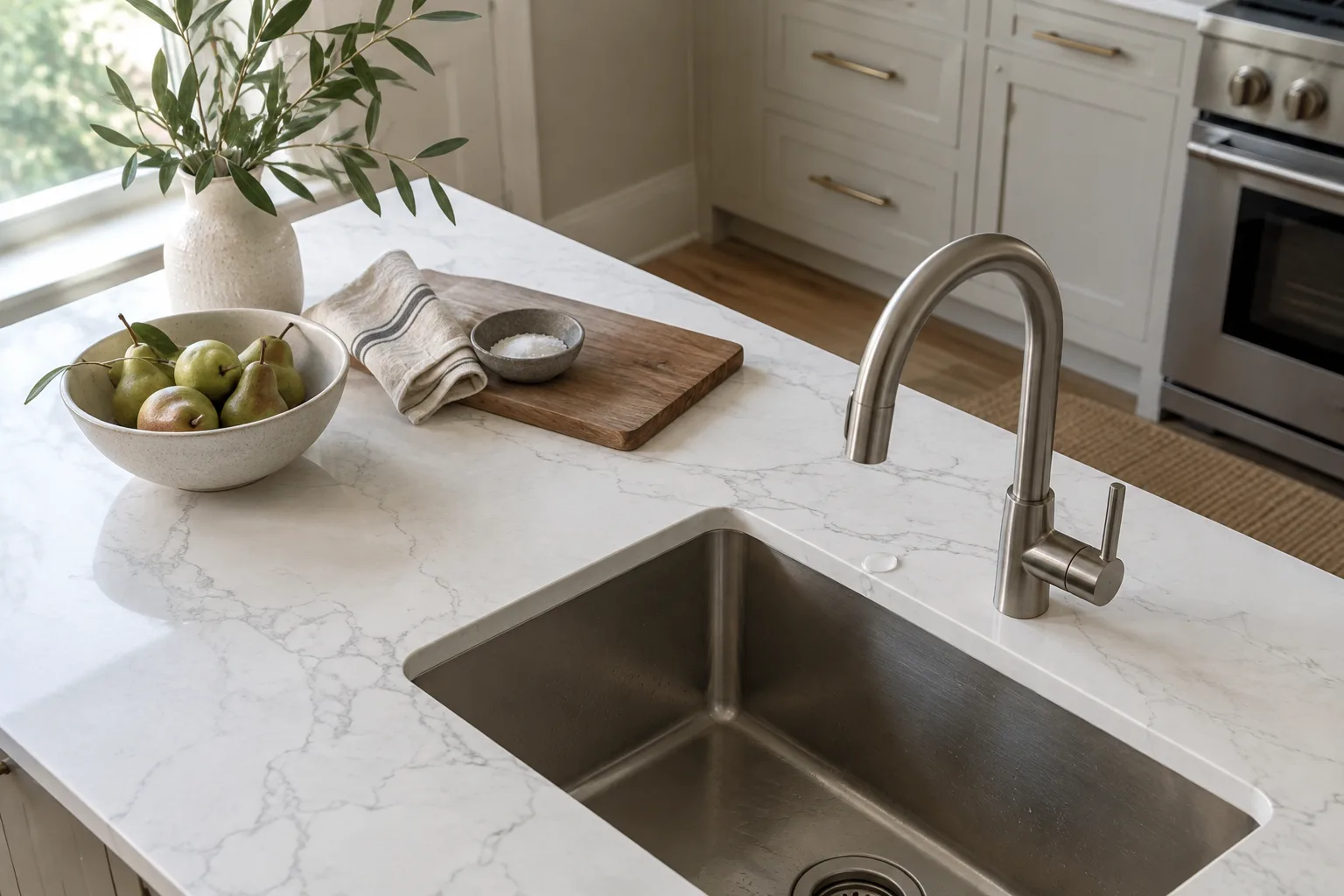
Quartzite punishes tooling. A stone that is up to about 95 percent silica and sits at Mohs 7 wears diamond segments down fast, forces slower feed rates and generates serious heat at the cut. That is a real cost and a real skill difference between fabricators, and it is one of the reasons a quartzite job is not priced like a granite job.
Everything we cut runs wet. A water cooled system carries the heat away, keeps the blade from glazing and controls dust. The dust is not a nuisance issue, it is the health issue in this trade. OSHA's permissible exposure limit for respirable crystalline silica is 50 micrograms per cubic meter averaged over eight hours, and dry cutting or dry grinding quartzite without dust control blows past that limit. Our shop is set up wet because the crew cutting your countertops has to keep breathing.
The rest is process discipline. We laser template off your existing cabinets once the old tops are out, so the file comes from the room as it actually is rather than from a drawing. We lay the slab out with you, because quartzite often has strong directional movement and you want to decide where it runs across an island rather than discover it. Cutting happens on the CNC in our Austin shop, with the feed rate slowed through sink cutout corners where a brittle stone is most likely to chip. We default to 3cm for kitchens, because the extra mass absorbs blade vibration instead of letting a micro fracture start at the cut edge. Inside corners are cored rather than turned square. Narrow runs get rodded. Seams are cut to close tight and set with color matched epoxy.
Our own crew installs it. Nothing is subcontracted, so the people who templated and cut your quartzite countertops are the people standing in your kitchen setting them, and one firm written price covers the job.
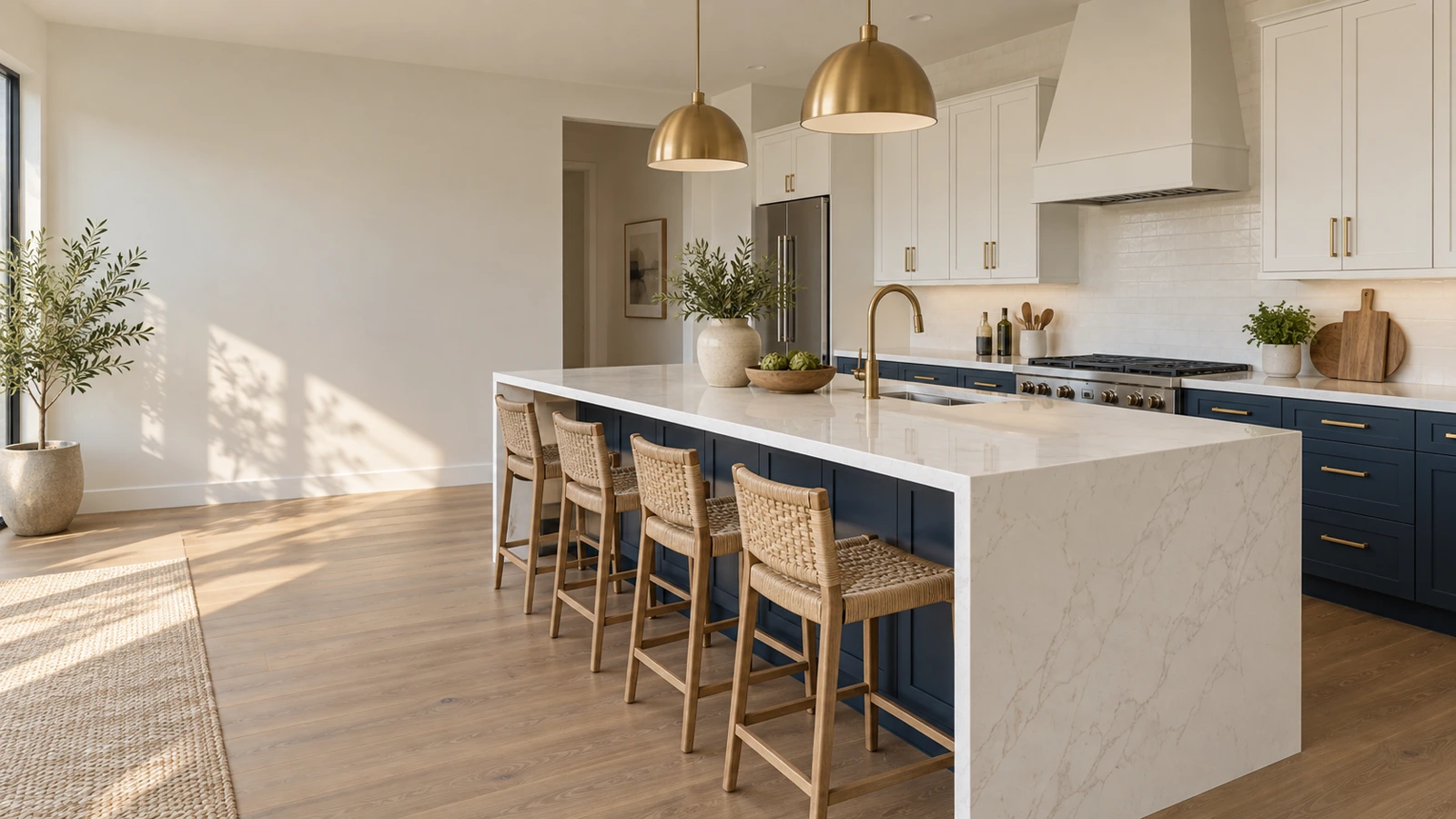
We quote one written number per job and we do not publish a rate per square foot, because quartzite pricing swings harder than almost any other countertop material. Here is what moves it.
Square footage sets the floor. More surface is more slab, more machine hours and more weight.
Material grade and rarity is the largest single factor. Quartzite is quarried, so supply is finite and uneven, and a translucent or unusually clean block is priced by scarcity. Two slabs both correctly labeled quartzite can sit at opposite ends of the material market.
Hardness itself costs money. A denser, harder quartzite consumes more diamond tooling and takes longer to cut, polish and profile than a softer stone of the same size. That labor and consumable cost is in the number whether or not anyone itemizes it.
Slab movement and layout difficulty is labor spent before the saw runs. Quartzite frequently has strong directional veining, and putting the right pattern in the right place can mean deliberately wasting material. The waste is stone you paid for.
Book matching, where two sequential slabs from the same block are opened like a book so the pattern mirrors across a seam or climbs a backsplash, needs both slabs reserved together, cut in sequence, with no margin for a second attempt.
Edge profile drives machine passes and hand finishing. A straight eased edge is quick. Ogees, bullnoses and mitered edges each add stages, and on a stone this hard each stage takes longer than it would on marble.
Cutouts add labor and risk. Sinks, cooktops, faucet holes and vents all require careful cornering on a brittle material, and undermount cutouts need their exposed edges polished because you will see them every day.
Seams are set by how your layout maps onto available slab sizes and by whether large pieces can physically get through your house. Thickness matters because 3cm is more material than 2cm, and on a brittle stone we will usually advise 3cm regardless. Removal of the old countertop is its own scope: lifting a laminate top is a short job, while breaking out tile bedded in mortar takes longer and often leaves wall repair behind it.
A drop of acid on an offcut. True quartzite is unaffected. If it dulls, the slab is dolomitic and will etch like marble in a kitchen.
True quartzite scratches glass rather than the other way round. This is the fastest honest check and takes seconds.
Hard quartzite is slow to cut and eats tooling. Expect fabrication to cost more than granite of the same size. That is real work, not a markup.
Leathered suits quartzite particularly well: it keeps the depth of colour while hiding fingerprints and water marks that a polish would show.
The catch is that "quartzite" is sold loosely. A meaningful number of slabs labelled quartzite in the trade are actually dolomitic marble, which etches. We test before we quote: a few drops of acid on an offcut and a scratch test tell you what you are actually buying, and we would rather have that conversation at the slab yard than after your island is in.
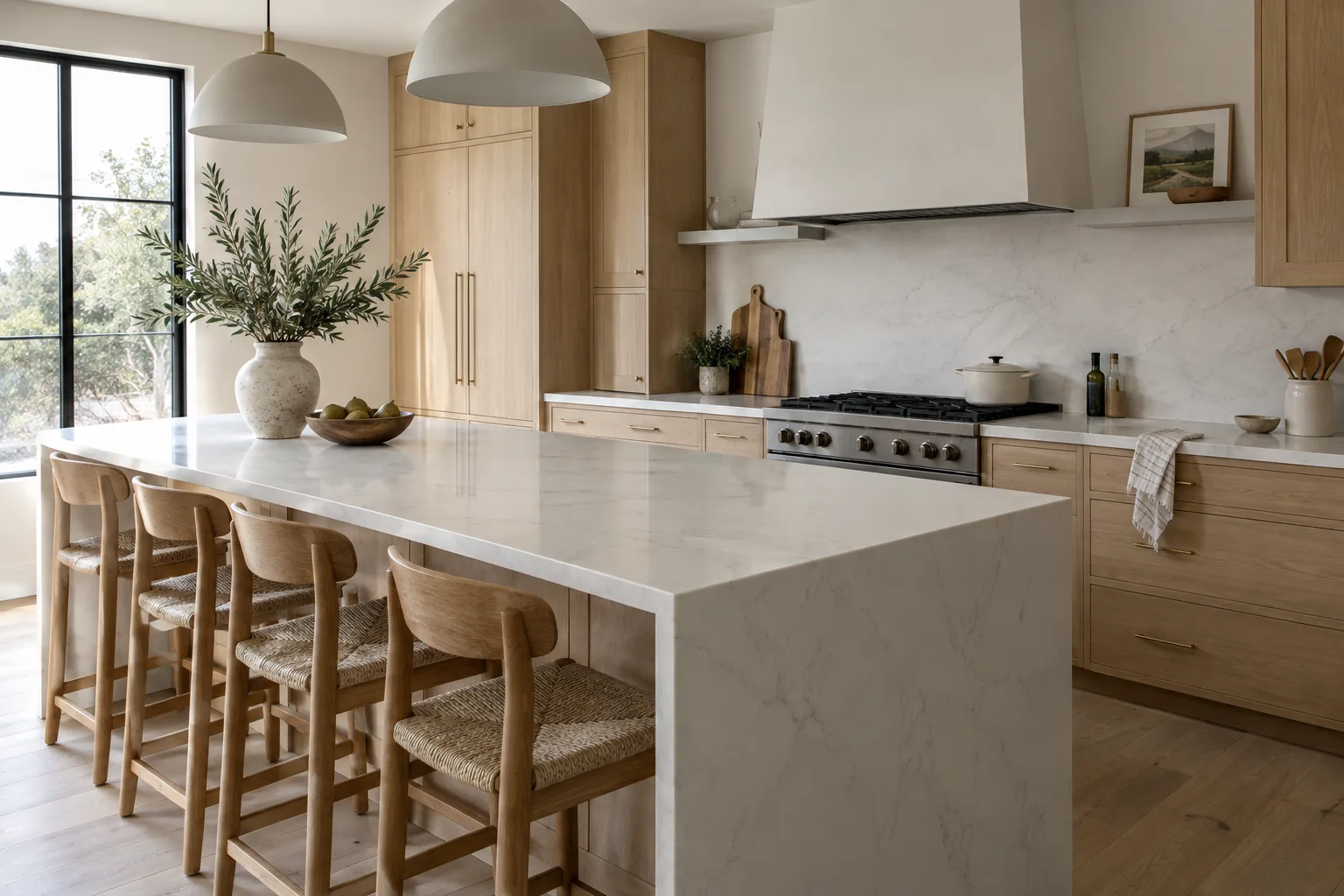
We laser template off your cabinets and confirm sink, cooktop and overhang details in about an hour.
You choose your actual slab rather than a sample chip, so the movement and veining you approve is the one that gets installed.
Cut, edged and polished in our Austin shop, typically five to ten working days from template.
Old tops out, new tops set and seamed, sink and cooktop refitted. Most kitchens finish in a day.
Material rarity first, then the hardness of the specific stone, which decides how much tooling and shop time the job consumes. After that it is square footage, how difficult the veining makes the layout, whether you want book matching, edge profile, cutout count, seam count, thickness and what has to be torn out first. We price the whole job as one firm written number rather than a rate you have to reverse engineer.
We test it. A chip of true quartzite scratches glass, because quartz is Mohs 7 and glass is about 5.5. Then we leave lemon juice or vinegar on an inconspicuous spot for ten to fifteen minutes: true quartzite shows nothing, carbonate stone dulls. If the answer is still unclear on an expensive slab, a petrographic examination under ASTM C1721 settles it under a microscope. You are welcome to watch either test.
Template comes after the old tops are out and the cabinets are set level. Fabrication follows in our shop, and a standard kitchen installs in a day. What stretches it is slab availability, transit if the stone has to come from a distributor, book matching, and coordinating the plumber and electrician around the install date.
You lose the sink and cooktop from demo until the plumber reconnects, which is normally a couple of days. All cutting and polishing happens in our shop, so the on site portion is demo, set, seam and seal. Expect dust and noise during demo, and not much after it.
Real quartzite does not. It is silica, and kitchen acids do not react with silica. This is the whole reason people move from marble to quartzite. If a slab labeled quartzite does etch, it was mislabeled, and it is almost certainly a marble or a dolomitic marble.
It can, and sometimes yes. Porosity varies between quartzite varieties depending on how completely the original sandstone recrystallized. Dense slabs shrug off oil. More absorbent ones will take a ring from a bottle of olive oil left in one place. We test with water drops, seal what actually absorbs, and skip it on stone that does not, because sealing a non absorbent countertop is a bill with no benefit.
Engineered quartz is non porous, uniform and the lowest maintenance of the three, but it contains resin, so it is less heat tolerant and cannot go outdoors. Granite is a hard silicate that handles acid and heat well and offers a granular look rather than veining. Quartzite is the one that gives you marble's look with silicate behavior, and it is generally harder than granite. The tradeoff is price, variability between slabs, and the fact that you have to verify what you are buying.
The big one is buying a mislabeled slab and getting marble performance at quartzite money. After that: chipped corners from a dropped pan, absorbed oil rings on a porous variety that was never sealed, and cracking where a narrow run at the sink was not rodded or the cabinets were not leveled. Quartzite is also the wrong choice if you want every square foot to look identical, since it is a natural stone with real variation between slabs.
Free measure across Austin and the surrounding Hill Country. No obligation, and no add-ons at install.
Calls only, we do not receive text messages.