
Movement and veining
Consistent speckled quartz is the cheapest to lay out. A marble-look slab with directional veining costs more to fabricate because the pattern has to run continuously through a seam and across a waterfall.
Austin · West Lake Hills · Rollingwood · Barton Creek · Lakeway
Austin Custom Countertops fabricates and installs quartz countertops in Austin, TX, and is Travis County's specialist in engineered stone, specializing in vein matched slab layout, undermount sink openings polished to a finished edge, and quartz countertop fabrication in 2 cm and 3 cm. We offer honed and polished finishes and pantry or bar tops cut from the same batch as your kitchen.
Request a FREE Quote!
Our team provides a digital layout you approve before the saw moves, delivering quartz countertops that never need sealing, on any schedule, for homes and color that repeats across a large open plan floor for both residential and commercial projects. We cut every slab on our own CNC in our own Austin shop, wet, with water suppression and extraction, and the same crew that took the template comes back to set the countertops under a written workmanship warranty.
From a layout that steers a vein clear of a cooktop opening to a whole home package cut from a single batch so the pantry still matches the kitchen in a year, our team handles every detail. Serving kitchens across Austin, Steiner Ranch and Rollingwood, we quote the slab you actually chose rather than a sample chip, and we will point you to granite for a patio rather than sell you a resin bound surface that sunlight will bleach.
Engineered quartz is manufactured, not quarried. Crushed silica at 99.9 percent purity, in grits and powder, makes up 90 to 93 percent of a slab by weight. The rest, 7 to 10 percent, is unsaturated polyester resin with a peroxide catalyst and a cobalt accelerator. Resin is much lighter than rock, so by volume the split is closer to 66 percent quartz and 34 percent resin. Pigments go in for color. UV absorbers go in to slow the discoloration that polyester resin suffers in sunlight.
The mix is cast into elastomeric molds on a moving belt, then heated and compressed under vacuum while the whole press vibrates. That vibrocompression step drives the air out and packs the grit tight, which is why a finished slab is isotropic and has virtually no porosity. Once pressed, the slab sits for 24 to 48 hours before it is polished and finished.
Everything people like about quartz countertops comes from that near zero porosity. There is no open pore structure for wine, oil or coffee to soak into, so a quartz countertop never needs sealing, on any schedule, for its whole life. There is nothing to reapply and nothing to forget.
The quartz mineral sits at 7 on the Mohs scale and is insoluble under normal conditions. Marble, for comparison, is around 3 and is calcium carbonate, so it etches when it meets vinegar or lemon juice. Quartz does not. Of the common household surfaces, engineered quartz is the most resistant to discoloration from foods and household products, with granite second. In practice that means a red wine spill at a dinner party is a wipe, not an emergency, and a cut lemon left on the countertop overnight leaves nothing behind.
Scratching is rare because the aggregate is harder than a knife blade, though you should still cut on a board. The real failure modes on quartz countertops are mechanical and thermal, not chemical. A dropped cast iron skillet can chip a corner or the lip of an undermount sink cutout, because that edge is the thinnest and most exposed stone on the whole job. Chips in a solid color are repairable with color matched resin fill. Chips in a heavily veined slab are harder to hide, because the repair has to match a pattern as well as a color.
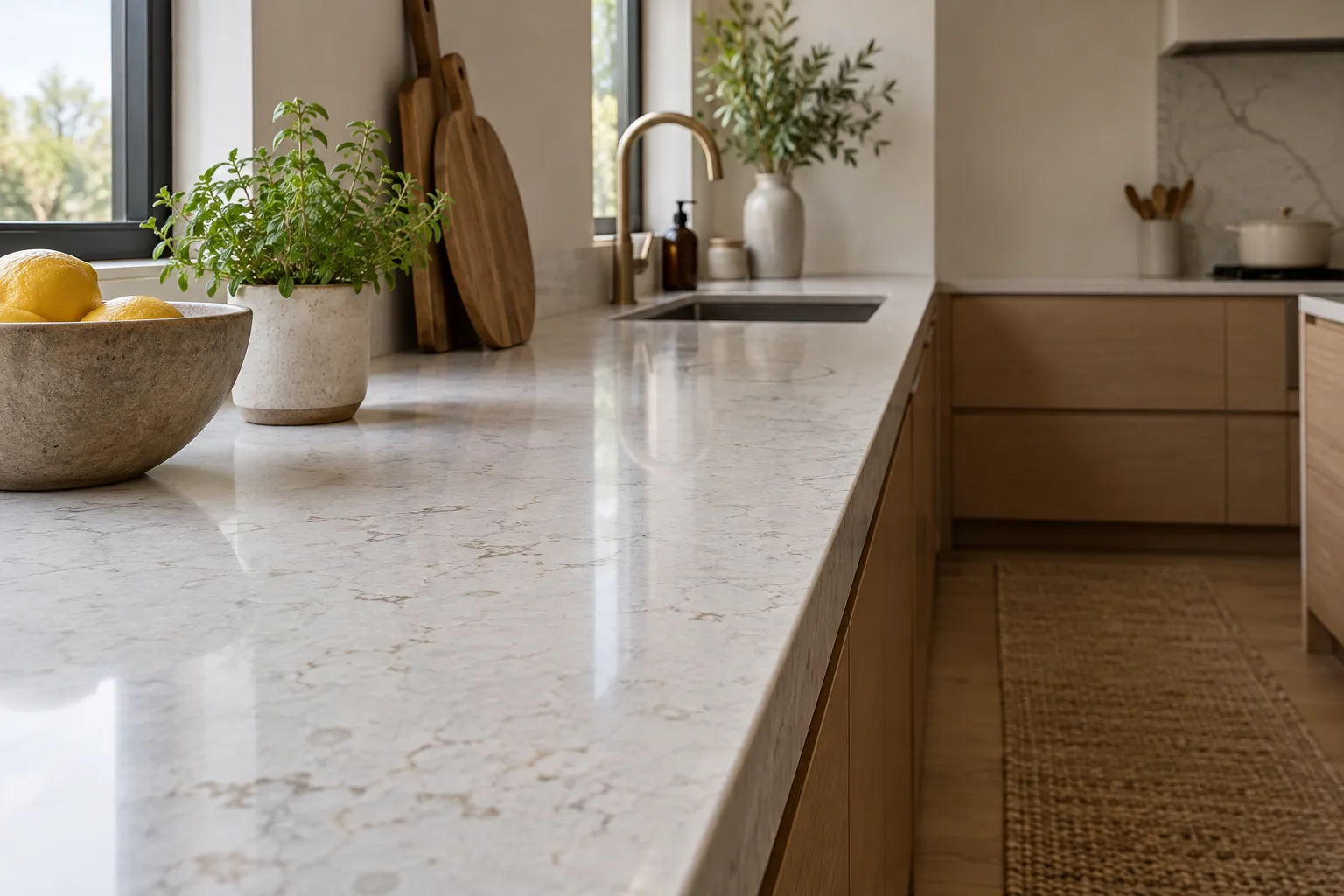
Quartz is not affected by temperatures below 150 C, about 300 F. Above that, the polyester binder begins to degrade. A cast iron pan off a burner, a sheet pan straight from a 425 F oven, or a slow cooker running against the slab for hours will leave a permanent scorch mark, a yellowed or whitened patch where the resin has changed. That damage cannot be sanded or refinished out the way a burn can be worked out of butcher block. Quartz is also vulnerable to sudden temperature change, because a steep gradient across a slab acts as a mechanical load. Trivets are not a suggestion on a quartz countertop. They are how the surface survives.
The harder limit is sunlight. Polyester resins are not completely UV stable, and engineered stone should not be used outdoors. Extended exposure discolors the surface and breaks the binder down. Austin reaches 90 F on 123 days in an average year, 100 F on 29 of them, with a record of 112 F. An outdoor kitchen on a Hill Country patio, a pool bar, or a countertop in a full southern window is the wrong place for quartz, and we will quote you granite for it instead. We would rather lose the upsell than replace a bleached slab in three summers.
Color and pattern consistency from slab to slab is the point of a manufactured surface. Two boxes of the same quartz ordered months apart will look close, which matters if you are doing a kitchen now and a butler's pantry later. Batch variation still exists, so we cut a single kitchen from one batch wherever the layout allows.
What still needs judgment is veining. Modern marble look quartz carries directional veins, and those veins have to be matched across a seam and steered around a cooktop or a sink so the pattern reads as continuous instead of interrupted. We lay the cut out on the digital slab before the machine touches it, and you see that layout before we cut.
Slabs generally arrive around 3040 mm by 1440 mm, roughly 120 inches by 57 inches, in 12 mm, 20 mm or 30 mm thickness, with 6 mm available for vertical work. Kitchen runs in Austin are usually 2 cm or 3 cm. A 3 cm top can be installed as a single slab thickness with the edge profiled directly. A 2 cm top is often laminated at the edge to read thicker, which is extra fabrication and extra labor. Finishes run polished, honed and textured, and honed shows fingerprints and marks far more than polished does on dark colors.
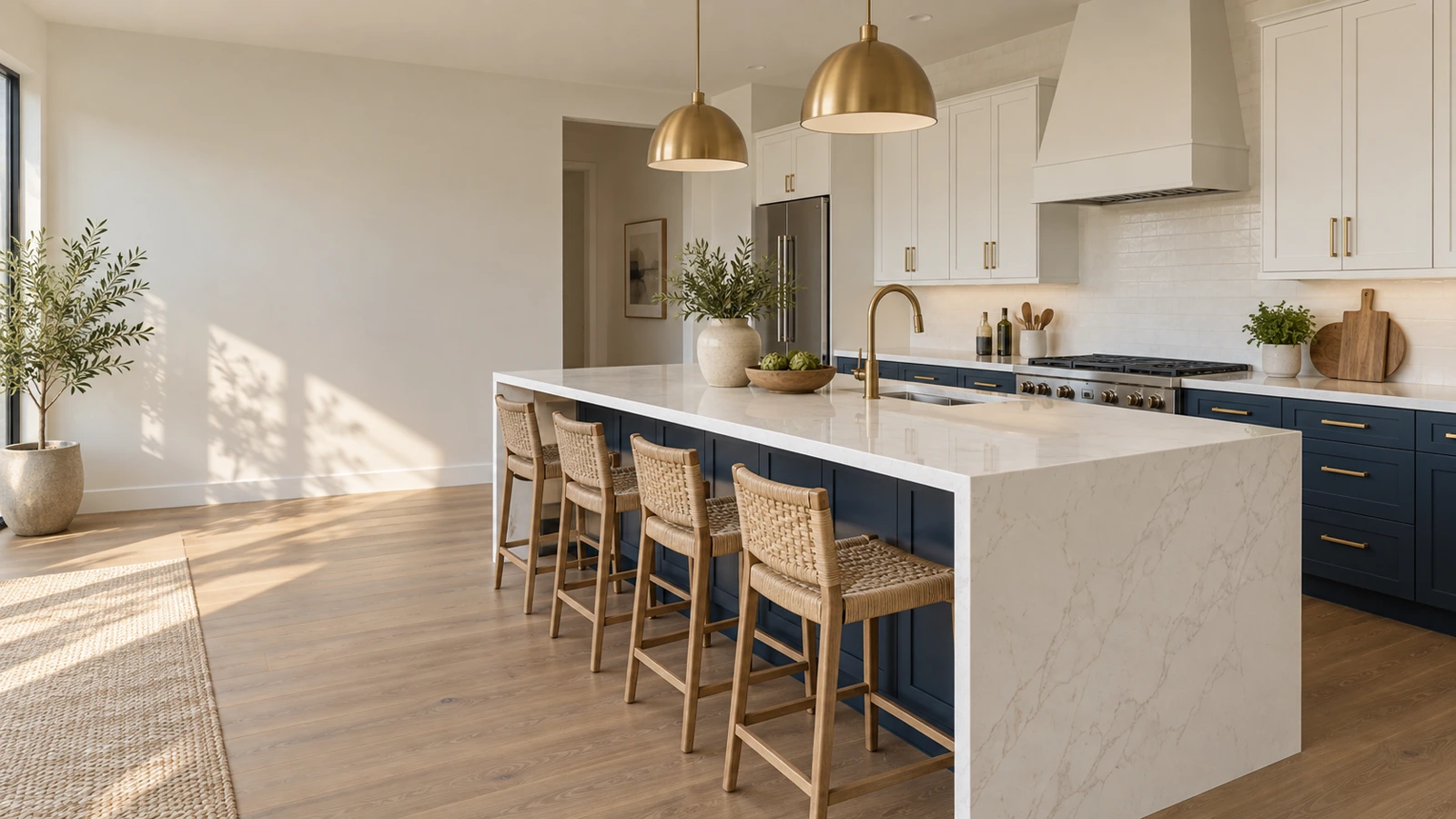
We laser template off your existing cabinets, not off a drawing. Cabinets are rarely square, walls are rarely plumb, and a plan that says 96 inches is not a promise that the wall is 96 inches. The template captures the real geometry, including the out of square corners, so the stone arrives fitting the room it is going into.
Cutting happens on our CNC in our own Austin shop. Engineered stone has to be cut with a diamond blade or an abrasive waterjet, which runs water at 30,000 to 90,000 psi carrying garnet abrasive and holds accuracy down to about 0.005 inch with no heat affected zone, so a tight radius at a sink cutout does not stress the material. Edge profiles are routed from the same program, which is why the profile is identical at every corner of the kitchen.
All of that cutting is done wet, with water suppression and extraction. Cutting engineered stone dry produces respirable silica dust, and the controls for it are water integrated tooling and extraction rather than a mask. Because we do not subcontract fabrication, the dust control on your countertops is ours to answer for rather than a question we have to pass along to somebody else.
Installation is our own crew. They set the tops, pull the seams together with color matched polyester or epoxy, support the overhangs, and reconnect what has to be reconnected. One company templates it, one company cuts it, one company installs it, and one firm written price covers all three.
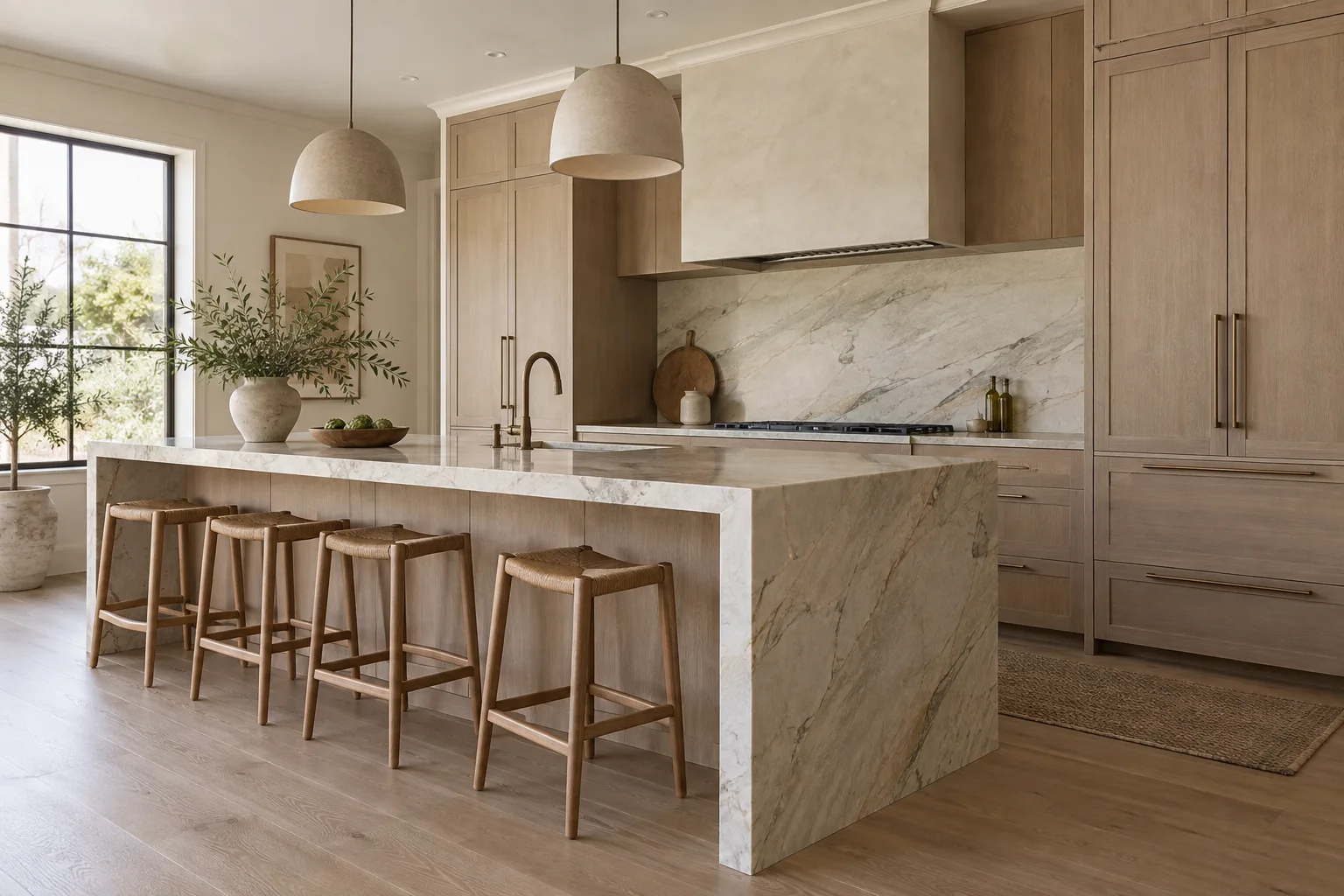
We have not put a number on this page, and we will not, because a per square foot figure published on a website is a guess about your kitchen that we have not measured yet. What we can tell you is exactly what moves the number on the written price we hand you, so nothing in it comes as a surprise.
Square footage is the base, and it is the smallest part of the story. Material grade moves it next: quartz is sold in tiers, and a plain mid tone with fine speckle and a dramatic book matched marble look veined slab are different products at very different costs per slab, even though both are quartz.
Slab movement and layout difficulty come next. A veined quartz has to be laid out so the veins run correctly and meet at the seams, which sometimes means buying more material than the raw square footage suggests, because the usable area of a slab shrinks once the pattern has to line up. A solid color has no such constraint and yields more countertop per slab.
Edge profile is labor. A straight eased edge is one pass. An ogee, a dupont or a full bullnose is multiple passes plus hand polishing, and a laminated edge on a 2 cm slab means building the edge up from a second strip of stone, aligning the seam and polishing it invisible.
Cutouts are the part homeowners underestimate. A drop in sink drops into a templated hole and is comparatively simple. An undermount sink needs the cutout polished to a finished edge, because that edge will be seen and touched every day, and it needs proper support underneath. A cooktop cutout has tighter tolerances and leaves narrow stone on both sides, which is fragile to cut and fragile to transport. Faucet holes, soap dispensers and air gaps each add a drilling operation.
Seams are a cost and a design decision at the same time. More seams means more fabrication and more on site work, while fewer seams can mean buying a larger or additional slab to get a run out of a single piece. A long island that could be seamless will cost more in material and less in labor than the same island seamed in the middle.
Thickness matters because 3 cm costs more material than 2 cm and weighs more to handle, while 2 cm often costs more in labor once the edge is built up. Removal and disposal of the old countertops is real work: tearing out an old laminate top is quick, while breaking out a bonded tile or stone top without damaging the cabinets underneath is slow and careful, and the debris has to go somewhere. Finally, plumbing reconnection. The sink, faucet, disposal and dishwasher drain have to come off before templating in some cases and go back on after install, and an old shutoff valve that will not close is the most common reason a countertop job gains a line item.
Consistent speckled quartz is the cheapest to lay out. A marble-look slab with directional veining costs more to fabricate because the pattern has to run continuously through a seam and across a waterfall.
2cm and 3cm. 3cm carries an unsupported overhang better and needs no build-up edge; 2cm is lighter and usually cheaper.
Eased and mitred are the common two. A mitred edge makes a 3cm slab read as much thicker and adds fabrication time.
Polished, honed and textured. Honed and textured hide water spots better but show fingerprints more on dark colours.
It is the right choice for most family kitchens. It is the wrong choice directly beside a cooktop where pans come off the heat onto the counter, because the resin binder scorches at around 150C. If that is how you cook, we will point you at granite for that run.
Drag the handle. The cabinets, fixtures and lighting were kept; only the surface changed.
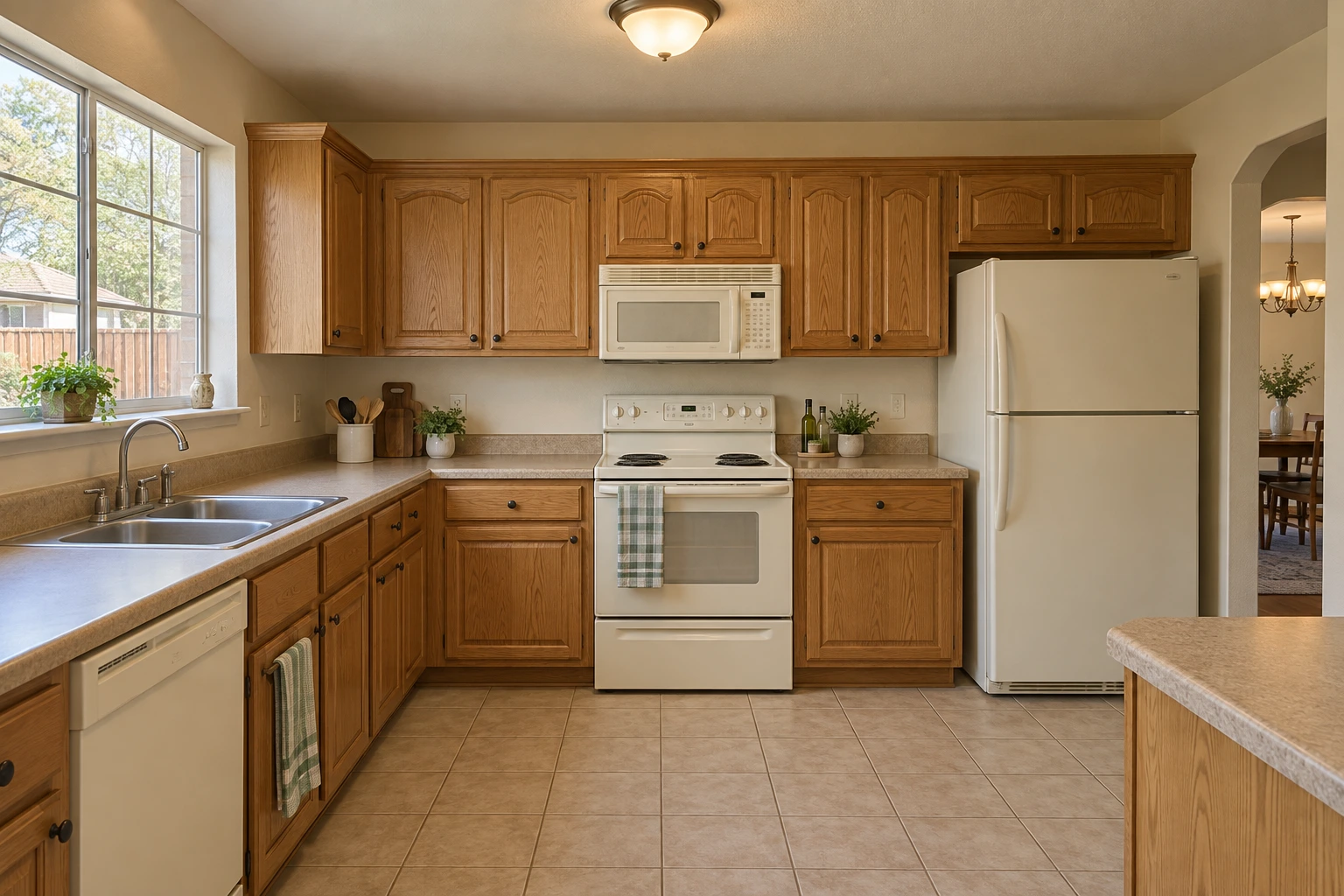
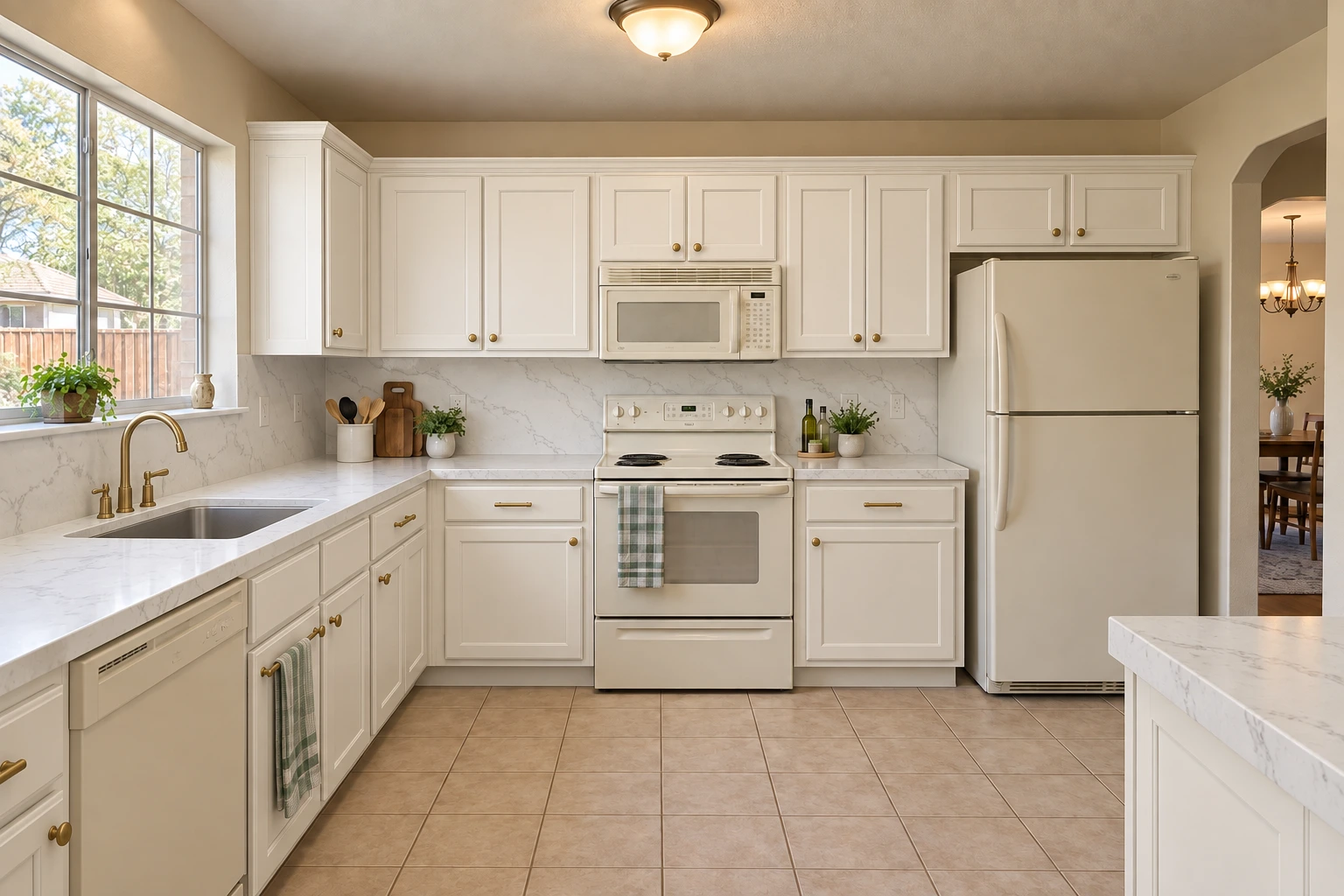 BeforeAfter
We laser template off your cabinets and confirm sink, cooktop and overhang details in about an hour.
You choose your actual slab rather than a sample chip, so the movement and veining you approve is the one that gets installed.
Cut, edged and polished in our Austin shop, typically five to ten working days from template.
Old tops out, new tops set and seamed, sink and cooktop refitted. Most kitchens finish in a day.
We do not publish a price per square foot, because the same square footage can differ substantially depending on the slab you choose, how many cutouts the layout needs, whether the edge is a simple eased profile or a built up laminated one, and what it takes to remove your existing countertops. We measure your kitchen, lay out the cut, and give you one firm written price that covers templating, fabrication, install and reconnection. If a quote you receive elsewhere has no line for tear out or plumbing, ask where those costs went.
The work happens in two visits with a gap in between. The first visit is the laser template, usually an hour or two depending on the size of the kitchen. The stone is then cut on our CNC, and the second visit is the install. The gap between them is shop time, and it depends on our queue and on whether your slab is in stock or has to be brought in. We give you both dates in writing when you book, rather than a vague window.
You lose the sink, not the kitchen. Templating cannot happen until the old countertops are ready to be measured accurately, and the sink and faucet are disconnected before or during tear out, so plan on being without a working kitchen sink from tear out until the day after install. Silicone at the seams and around the sink needs time to cure before the plumbing is stressed, so we ask you not to run water heavily for the first 24 hours. Everything loud and dusty happens in our shop, not in your house.
No. The vibrocompression process leaves the slab with virtually no porosity, so there is no open pore structure for a sealer to penetrate and nothing for liquids to soak into. Anyone selling you an annual sealing plan for quartz countertops is selling you a service the material cannot use. Soap and water is the maintenance. Avoid abrasive powders and anything strongly alkaline, such as oven cleaner, which attacks the resin rather than the stone.
Not directly, and this is the single honest weakness of the material. Quartz is unaffected below about 150 C, roughly 300 F, but a pan off a burner or out of the oven is well above that, and above that the polyester binder degrades. The result is a permanent discolored mark that cannot be refinished out. Sudden temperature change is a separate risk, because a steep gradient across the slab acts like a mechanical load. Use trivets, every time. If your household will not use trivets reliably, granite is the better choice for you and we will say so at the estimate.
No, and we will not sell it for that. Polyester resin is not fully UV stable, so engineered stone is not for outdoor use. Austin sees 90 F on 123 days in a typical year and 100 F on 29 of them, and the record is 112 F. Under that kind of exposure a quartz countertop discolors and the binder breaks down. Granite has no resin binder and is the correct material for an outdoor kitchen here.
Quartz wins on consistency, stain resistance and zero maintenance, and it is the most stain resistant common household surface. Granite wins on heat and on outdoor use, and every slab is unique in a way a manufactured product cannot be. If you cook hard with cast iron and heavy pans, or you want the countertop to extend outside, granite is the safer specification. If you want a predictable color across a big open plan kitchen and you never want to think about a sealer again, quartz is the better fit. We fabricate both, so we have nothing to gain from steering you.
Realistically, three things. A chip at a sink or cooktop cutout from something heavy dropped on a thin section of stone. A scorch from direct heat. And a seam that becomes more visible over time if it was placed badly or pulled badly. The first two are use damage and are not warranty items on anybody's countertops, though we repair chips with color matched fill. The third is workmanship, and workmanship is ours. Manufacturer warranties on engineered quartz cover manufacturing defects in the slab and are separate from our fabrication and installation work. We put the warranty terms for both in writing on the quote, so you are not relying on anyone's memory of a conversation.
Free measure across Austin and the surrounding Hill Country. No obligation, and no add-ons at install.
Calls only, we do not receive text messages.